


OUR QUARTERLY NEWSLETTER TO CLIENTS AND FRIENDS OF THE FIRM
SECOND QUARTER 2026
IPO Exuberance and Picking Winners
Few financial events this year generated more excitement than the SpaceX IPO—a fitting occasion to revisit former Federal Reserve Chairman Alan Greenspan’s famous warning about “irrational exuberance.” Greenspan coined the phrase in 1996 to describe the excessive optimism surrounding internet stocks. Many dismissed his comments at the time, yet history proved him correct when the NASDAQ Composite ultimately lost nearly 80% of its value in the dot-com collapse. His warning, however, arrived more than three years before the market peaked—a reminder that enthusiasm can persist far longer than fundamentals alone might justify.
Identifying a revolutionary technology is
often far easier
than picking
the winners
An Initial Public Offering is the first time a privately held company offers shares on a public exchange, typically to raise capital or to provide liquidity for founders, employees, and early investors. From an investment perspective, however, an IPO is primarily a financing event for the company and a liquidity event for existing shareholders—not necessarily a chance for new investors to buy at an attractive valuation. Decades of academic research bear this out: on average, newly public companies have underperformed the broader market by roughly 1% over their first year.1
Underwriters also have strong incentives for an offering to be viewed as a success. To stimulate demand, shares are often priced modestly below what institutional investors expect to pay, creating the familiar “first-day pop.” While this generates positive headlines, much of that initial appreciation is captured by institutions that receive allocations before most individuals can participate.
SpaceX appears to be no exception. In the first few days on the market, shares surged to more than $200 per share before retreating toward their initial trading price of around $120 today. Meanwhile, the company’s narrative has broadened from space exploration to AI infrastructure, satellite communications, and space-based computing. At its IPO price, SpaceX traded at an extraordinarily high multiple of revenue despite inconsistent profitability. Investors are effectively valuing what the company could become over the next decade rather than what it earns today.
SpaceX’s expanding ambitions point to a deeper lesson. Firms that once had little connection to artificial intelligence now routinely position it at the center of their strategy, a reminder that identifying a revolutionary technology is often far easier than picking the winners that will ultimately profit most from it. Consider the early internet. Numerous web-browsers competed for dominance, including Lynx and Netscape, yet the company that became one of the greatest technology success stories was Google, who was neither the first browser nor an early entrant. More importantly, many of the internet’s largest economic winners were simply businesses that learned to use the technology more effectively than their competitors.
The same dynamic may unfold with artificial intelligence. Today’s AI developers understandably receive most of the attention, but tomorrow’s biggest winners may instead be companies that deploy AI to automate operations, improve customer experiences, reduce costs, or accelerate scientific discovery. Pharmaceutical firms discovering breakthrough drugs, manufacturers optimizing production, and financial firms improving productivity may ultimately generate greater shareholder value than some of the companies building the underlying technology.
Artificial intelligence is a revolution that stands to change society as profoundly as the internet before it. Still, many of that era’s pioneers have come and gone. Whether the anticipated public debuts of leaders like Anthropic and OpenAI ultimately reward long-term shareholders remains, as always, an open question.
Successful investing does not depend on identifying the next headline-grabbing IPO or predicting a revolution’s winners with concentrated bets. History continues to support a disciplined approach built on broad diversification, thoughtful asset allocation, tax efficiency, and long-term ownership of exceptional businesses.
THIS QUARTER’S WINNER
This quarter’s best-performing asset class was one many investors overlook entirely: Emerging Markets.
Two of the largest countries within Emerging Markets—Taiwan and South Korea—have become indispensable participants in the global AI revolution. From advanced semiconductor manufacturing to memory chips and critical hardware infrastructure, these economies sit at the center of the technology supply chain powering artificial intelligence worldwide.
Last year, a meaningful portion of international outperformance resulted from a declining U.S. dollar. This quarter, however, geopolitical uncertainty surrounding the conflict with Iran has strengthened the dollar as investors sought traditional safe-haven assets. Despite that currency headwind, Emerging Markets continued to produce exceptional returns.
Year-to-date, Emerging Markets have appreciated more than 20%, another reminder of why we advocate globally diversified portfolios. While the U.S. market remains near all-time highs, leadership within global markets continually rotates, and no one can consistently predict which region will lead next.
Diversification is not simply about reducing risk. Increasingly, it is proving to be a powerful source of longterm investment returns.

Stock Gains Without All the Taxes? How the Hottest Trade on Wall Street Works.
The stock-market surge has propelled the use of a new kind of tax-loss harvesting. We break it down.
By Miriam Gottfried & Peter Santilli
May 16, 2026 at 7:00 pm ET
With the stock market near record highs, it isn’t enough to be winning anymore. Wealthy investors are now obsessed with losing, too.
The hottest investment on Wall Street promises a magical-sounding mix of both: Index-beating performance that also comes with losses to off set capital gains taxes.
Millions of investors are sitting on big gains in concentrated stockholdings, be they shares of Magnificent Seven tech giants, plain-vanilla index funds or employee shares of hot tech companies.
The traditional move would be to turn to direct indexing, a form of tax-loss harvesting that has been an investing mainstay since the early 2000s. There is now $1.1 trillion invested in that strategy, according to research firm Cerulli Associates.
But for many investors who have ridden this ebullient stock market, direct indexing is no longer generating the losses it once did.
So financial advisers are trying to turn up more losses for their clients by employing strategies that use leverage. Over $150 billion has flowed into this newer breed of tax-loss harvesting, known as long-short tax-aware, or tax-aware alpha, according to Brent Sullivan, who writes about the industry on his Substack, Tax Alpha Insider.
The strategy comes with some risks for investors.
If the S&P 500 is up 15% for the year, the goal is for the client’s portfolio to rise that much, while also distributing losses. These losses could be used to offset gains in highly appreciated securities elsewhere in the portfolio.
How the long-short strategy works
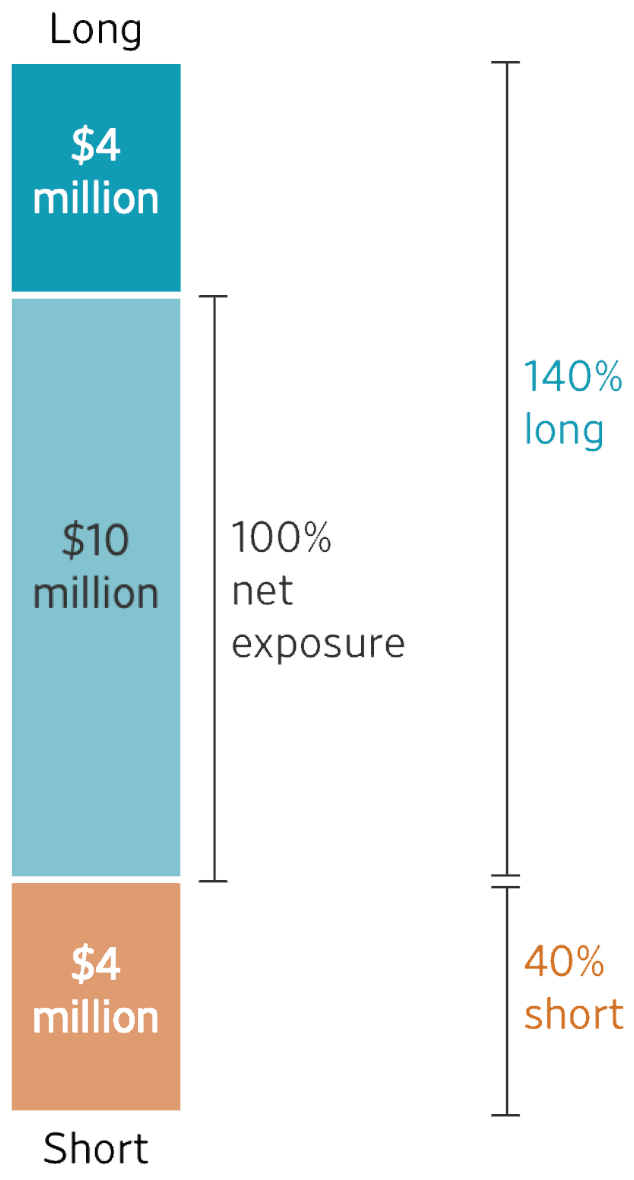
An investor with $10 million would go to a long-short manager who would invest the money in a basket of stocks. But they would also
borrow against the investment to create two “extensions,” longs that bet on the stocks and shorts that bet against them.
In a 140-40 portfolio, for example, the manager would be going long and short by an additional $4 million, respectively.
The investment is now 140% long and 40% short, which can amplify returns, while providing more opportunities for tax losses to harvest.
The investor’s net exposure would still be $10 million, or 100% net long.
The leverage amplifies both the losses and the gains relative to the investor’s overall position. It also generates losses on the shorts that go up in addition to the longs that go down, so there is greater potential for losses to harvest.
But direct indexing gradually loses steam as a method of generating losses as the market continues to rise. Around half of such portfolios industrywide are now “ossified,” meaning they are no longer generating losses, estimates Jon Diorio, head of U.S. wealth product at BlackRock.
A new strategy took shape. Hedgefund firm AQR Capital Management developed the tax-aware long-short strategy for clients such as family offices and ultrawealthy individuals. Around five years ago, the firm and its rival, Quantinno Capital Management, began allowing individual investors and their advisers to tailor the strategy inside their own separately managed accounts, or SMAs.
Custodians, most notably Fidelity Investments, made the strategy accessible by lowering the investment minimums. It was a hit. AQR now manages nearly $70 billion in taxaware long-short strategies, roughly 80% of which is in SMAs. Quantinno manages more than $48 billion. They have spawned numerous imitators.
Long-short managers generally aim for “alpha,” meaning they want to outperform the benchmark in addition to harvesting losses. The strategy must balance these aims.
The strategy has become so popular that Fidelity and Charles Schwab have recently instituted limits on new accounts.
Both strategies come with risks. Direct-indexing managers might not succeed in tracking the index if they can’t find appropriate substitutes for the stocks they sell. The Internal Revenue Service’s “wash sale” rule limits the ability to recognize a loss on the sale of stock if the same stock is purchased within 30 days before or after the sale.
But holding on to the winners means new gains can build up over time within the strategy. Investors must eventually pay taxes on these if they cash out.
Michael Paulus, founder of wealth manager PCM Encore, recommends direct indexing for nearly all his clients, particularly those close to retirement who will need to sell highly appreciated stocks to fund it. Direct-indexing managers charge annual fees as low as 0.05%.
But he is more cautious about using long-short SMAs. He has used them for clients expecting a major onetime gain such as from the sale of a business or for clients who work in tech and get a large portion of their pay in stock. He otherwise avoids them.
Tax-aware long-short strategies can cost as much as 1.5% to 3%, including investment management, financing and borrowing fees.
“All else being equal, I’d probably rather cut the government a check than a hedge fund in Connecticut,” Paulus said.
Neither direct indexing nor longshort SMAs are likely to eliminate all capital gains in a bull market like this one. The losses they generate are often used to offset gains in other areas of the portfolio. For example, someone selling a stake in a business at the beginning of the year could invest the money into a long-short SMA to generate losses to offset some of their capital gains by the end of the year.
Disclosures: Past performance is no guarantee of future results.
1: Dimensional – Do IPOs Have a Place in Your Portfolio? September 2025