


OUR QUARTERLY NEWSLETTER TO CLIENTS AND FRIENDS OF THE FIRM
THIRD QUARTER 2025
Bonds Are Back
For more than a decade, fixed income investors faced a sobering reality: yields on high-quality bonds were persistently low. In the wake of the 2008 financial crisis, central banks across the globe, including our own Federal Reserve, slashed interest rates to near-zero levels in an effort to stimulate economic growth. The result was an era of ultra-low interest rates that left bond investors with few attractive options.
Diversified portfolios, especially those built on the very basic 60/40 stock-bond model, faced muted returns from the bond side. For many, bonds became less about income and more about ballast—something to hold during equity drawdowns but not to drive returns.
But that narrative is changing—and fast.
What Drove Interest Rates Higher?
The dramatic rise in interest rates over the last two years has been one of the most important (and underappreciated) developments in capital markets. Triggered by a post-COVID surge in inflation, the Federal Reserve embarked on its most aggressive tightening cycle in 40 years. From March 2022 through late 2023, the Fed Funds rate jumped from 0.25% to over 5%, sending shockwaves across investments of all types.
This reset was painful in the short term, 2022 was the worst year for bonds in modern history, but it has laid the groundwork for a vastly improved forward-looking return profile. That story has been quietly playing out in 2025.
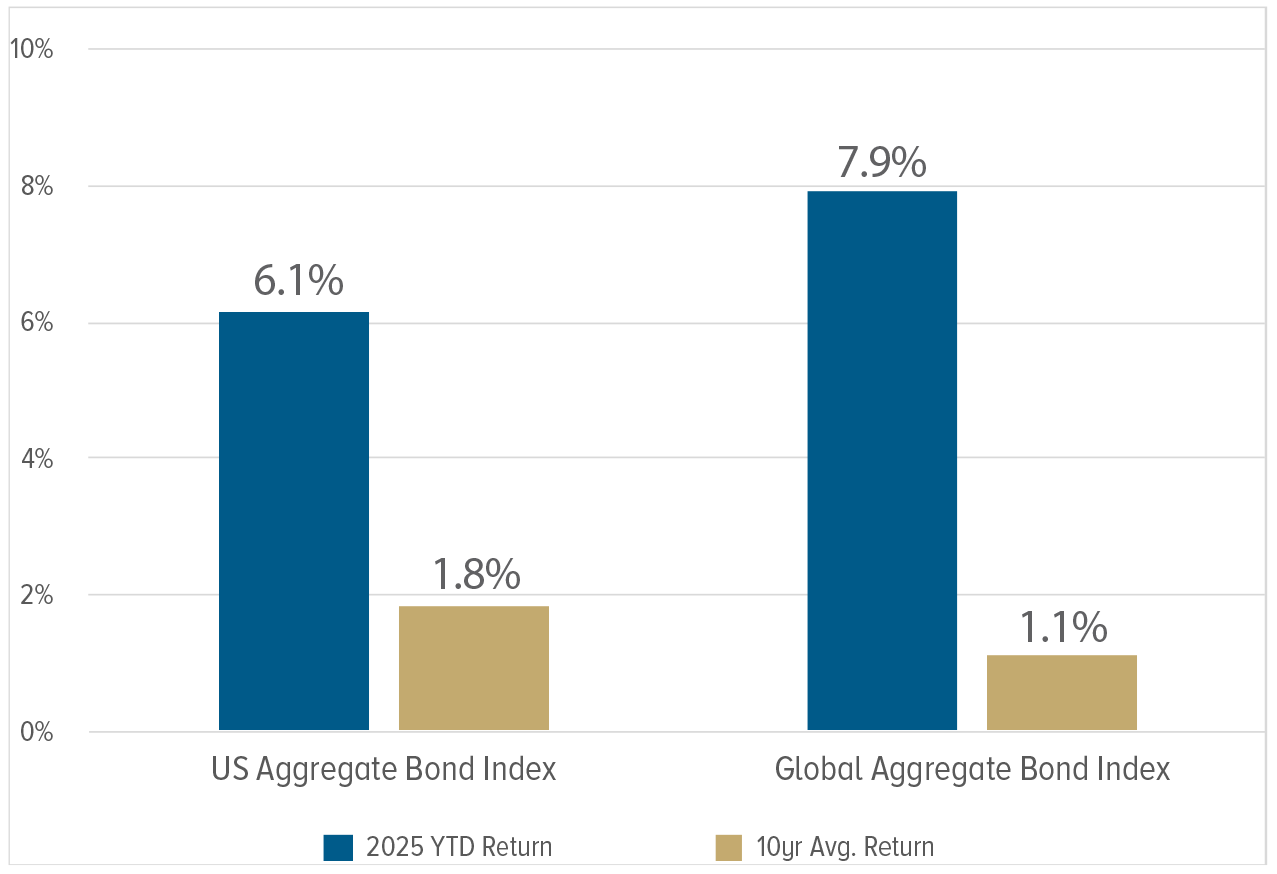
Figure 1
2025: A Banner Year for Bonds
A Remarkable Comeback for Fixed Income
The chart in Figure 1 tells a powerful story. Through the first three quarters of 2025, the U.S. Aggregate Bond Index has climbed 6.1%, while the Global Aggregate Bond Index has delivered an impressive 7.9%. If current momentum continues, 2025 is on track to be the strongest year for bond returns in over a decade. This marks a dramatic departure from the subdued performance of the past ten years, when yields on high-quality bonds hovered at 1-2% annually.
A Rare Bright Spot Ignored by the Headlines
Despite these impressive numbers, this shift in the bond market has been largely overlooked in the financial press. That’s unfortunate—because for the thoughtful, diversified investor, this is very good news.
Higher interest rates have restored the ability of fixed income to contribute meaningfully to overall portfolio returns without requiring excessive credit or term risk.
Importantly, these returns are not dependent on strong equity markets or economic surprises. They are driven by yield, the most reliable and contractual component of total return.
Even as Rates Ease, Bonds Still Look Attractive
Some may wonder if this opportunity has passed, especially now that the Fed has begun cutting interest rates. Even as yields modestly decline, they remain well above the recent past. The income earned on today’s bond portfolios continues to compound at attractive rates, and reinvestment risk has been manageable given the flatter trajectory of future rate cuts.
The Dollar’s Decline is a Boost to Global Bonds
There’s a quiet but meaningful tailwind supporting globally diversified investors: the U.S. dollar is weakening. After years of strength, the dollar is now under pressure as markets begin to anticipate lower interest rates and rising fiscal challenges. For U.S.-based bond investors with international exposure, this shift matters. When the dollar weakens, foreign bonds—denominated in local currencies—gain value when converted back into dollars, boosting returns. This currency effect has been a significant contributor to global bond performance. All things considered, 2025 has marked a clear turning point—bonds are officially back.
Gold at All-Time Highs:
Should It Have a Place in Your Portfolio?
With gold recently reaching new all-time highs, it’s natural for investors to wonder whether the yellow metal deserves a place in a modern, diversified portfolio. While gold can act as a temporary safe haven during periods of market uncertainty or geopolitical stress, the long-term data suggests that its role in strategic asset allocation is limited, especially for growth-oriented investors.
Since the early 1970s, when gold was decoupled from the U.S. dollar, its returns have lagged well behind the U.S. stock market. Stocks represent productive assets: businesses that generate earnings, pay dividends, and grow with the economy. Gold, by contrast, is inert. It doesn’t generate cash flows, and its value is largely sentiment-driven.
Although we don’t invest in gold itself, our managed futures strategies do capitalize on price trends in gold as well as dozens of other assets. This approach to commodity investing allows investors to benefit from gold’s momentum while maintaining a more flexible and risk-managed portfolio.
In short, while the headlines may tempt you, gold’s recent rally is not a reason to deviate from a disciplined, evidence-based investment strategy. We continue to believe that a globally diversified portfolio offers the best path to long-term financial success.
Disclosures: Past performance is no guarantee of future results. For illustrative purposes only.

Could the U.S. Dollar Lose Its Dominance?
It Did Once Before.
The U.S. currency’s rise and fall from prominence in the early 20th century offers
lessons for today’s political leaders.
By Barry Eichengreen
Sept. 11, 2025 at 10:00 am ET
Is the U.S. dollar’s position as the world’s reserve currency on shaky ground?
Some people think so, pointing to President Trump’s tariffs, America’s growing debt and its use of financial sanctions as a foreign-policy tool. Russia, barred from using the dollar in 2022, has shifted to using the Chinese renminbi for its international transactions. Other countries are exploring alternatives, as well, amid concerns that America’s outsize engagement in the global economy could end and debt will force the Federal Reserve to keep policy rates low, fueling inflation and dollar depreciation.
To many others, however, such claims seem far-fetched. The very fact that the U.S. currency is so widely used, and that the U.S. economy is so large, means its international role is secure.
But those espousing this Panglossian perspective forget that the dollar lost its primacy once before. It is a story worth retelling.
The dollar’s rise
The dollar wasn’t used internationally at all before World War I, when Britain’s pound sterling was the world’s currency. U.S. banks weren’t permitted to branch abroad and America had no central bank to backstop its financial markets.
That changed following passage of the Federal Reserve Act in 1913, which created that central bank and permitted American commercial banks to branch overseas.
The Fed’s founders, who needed to overcome Americans’ deep-seated aversion to concentrated financial power, had various motivations for wanting to create a new U.S. banking system. Carter Glass of Virginia, the crusty, self-styled financial expert in the U.S. House and co-sponsor of the Glass-Owen Federal Reserve bill, sought a decentralized system of public banks to provide credit to financially underserved Southerners. Nelson Aldrichof Rhode Island, influential chairman of the Senate Finance Committee, wanted a European style central bank, along the lines of
the Bank of England or the German Reichsbank, to mitigate financial crises.
For Paul Warburg, the cerebral, mustachioed German-American banker and one of the country’s most influential financial commentators, America’s dependence on sterling was a competitive disadvantage because it forced U.S. exporters to source trade credit abroad and shoulder exchange rate risk. Warburg lobbied for a central bank to make a market in dollar trade credits, essentially short-term IOUs that function as a promise of future payment. Warburg’s bank would stand ready to buy those credits, known as trade acceptances, at a preset price, making their cost and availability steady and predictable and allowing U.S. importers and exporters to use the dollar to finance their trade.
Warburg’s vision became reality when he accompanied Aldrich to a secret meeting in 1910 on Jekyll Island, off the coast of Georgia, where a group of prominent bankers hammered out the essentials of the Federal Reserve Act. President Woodrow Wilson appointed Warburg to the Federal Reserve Board, a perch from which he encouraged the Fed to support the nascent dollar credit market. Warburg advocated relaxing restrictions on the types of credits the Fed could purchase or discount, giving the central bank a role in financing not just merchandise trade, but purely financial transactions such as short-term loans and then dollar acceptances originated by foreign banks, as well. To further promote the market, Warburg in 1919 founded the American Acceptance Council to be a policy advocate for the industry.
In 1921, he formed the International Acceptance Bank, under whose umbrella a consortium of banks provided dollar finance for foreign trade.
By the late 1920s, largely through the efforts of this one man, New York had become the leading source of trade credit, and the dollar had supplanted sterling as the leading international currency. To be sure, Warburg’s efforts were supported by favorable structural conditions. The U.S. was the single largest economy from 1880. It became the leading national exporter in 1913. After World War I it had the largest financial markets, and it was the leading source of foreign loans. Thus, there was nothing paradoxical about the dollar’s rise—other than how long it had taken to get there.
The dollar’s fall
But what was gained could equally be lost. Starting in 1929, with the onset of the Great Depression, U.S. imports and exports fell. The Smoot-Hawley Tariff and the foreign retaliation that followed dealt trade another blow.
Three devastating financial crises disrupted the flow of finance and discouraged importers and exporters from relying on the U.S. banking system.
At this time, a third of all outstanding dollar acceptance paper held by U.S. banks and the Federal Reserve had originated abroad, mostly in Germany. In the aftermath of hyper inflation in 1922-23, the German public remained understandably reluctant to entrust its savings to domestic banks. Those cash-strapped banks lent to German importers and exporters only at double-digit interest rates. American banks, flush with funds and finding those rates irresistible, provided trade credit to German banks, which passed it on to German firms. The dollar acceptance market was now underwriting the transactions of foreign, as well as American, merchants and producers, signifying the U.S. dollar’s greatly expanded international role.
It all came tumbling down when distressed U.S. banks stopped lending. The German government responded with a moratorium on the country’s debts, including its acceptance credits. U.S. banks, including the Federal Reserve Banks, were left holding the bag. That is to say, they were left holding potentially worthless foreign acceptance paper.
The Fed refused to step in and sustain the market, compounding the problem. The sharp decline in the share of dollar acceptances purchased by the Reserve Banks spawned an equally sharp decline in the value of acceptances issued in the U.S. By 1934 the value of dollar acceptances had fallen to barely half their sterling equivalent.
Why was the dollar’s international position allowed to erode so dramatically?
First, personnel mattered. Benjamin Strong, the influential governor of the Federal Reserve Bank of New York,was a confidant of Warburg, arguably his dearest friend. A die-hard internationalist, Strong appreciated the role of the Fed in supporting the global dollar. Strong died from tuberculosis in His successor, George Harrison, was less attuned to the need to support the market in dollar trade credits.
Second, politics mattered. Glass had ascended to the Senate, where he chaired the influential Subcommittee on Banking and Currency. Glass blamed the Wall Street boom and bust on lax Fed regulations, adopted at Warburg’s insistence, and on Strong’s hyperactive support of the dollar acceptance market. Their actions, in his view, had fueled reckless speculation leading to the financial collapse, a view echoed by President Herbert Hoover. Glass now pressured the Fed to limit its purchases to acceptances financing merchandise trade. These “real bills” were safely collateralized by underlying merchandise, so they were guaranteed to perform. And because they financed legitimate economic activity, discounting them wouldn’t fan financial speculation.
Sensitive to the criticism, the Reserve Banks curtailed their operations. Commercial banks, uncertain now about whether the central bank would guarantee the liquidity of the market, grew more reluctant to purchase acceptances. Eventually, America recovered from the Great Depression. Its once vital international acceptance market didn’t.
It wasn’t until after World War II that the dollar became the leading global currency once again, in effect by default since the U.S. economy was the only one left standing. The Fed, having been chastened by the earlier experience, now acknowledged its responsibility to act as lender and liquidity provider of last resort, and thereby to promote and sustain the dollar’s dominant international role. That led to a remarkable streak of financial stability in the quarter-century following the war.
The lessons for 2025 are clear. The dollar’s international primacy isn’t eternal. To be sustained, it has to be actively fostered and preserved. It must be supported by competent officials. An astute, experienced Federal Reserve head is key. Politicians interfere at their peril.