


OUR QUARTERLY NEWSLETTER TO CLIENTS AND FRIENDS OF THE FIRM
FOURTH QUARTER 2025
2025 Year in Review
It’s that time of year when we reflect on the dynamics that shaped last year’s investment performance and evaluate the implications for our portfolio as we move forward. Last year was marked by double-digit returns across numerous asset classes in an inflationary environment that is getting back to “normal.” We recommend logging into your client portal to see how your portfolio has performed.
KEY TAKEAWAYS
- Emerging Markets outperformed with an impressive 34.3%, finally recovering from COVID and supported by strong commodity demand.
- International Developed Stocks delivered a remarkable 32% return and benefitted from strong economic policies plus a return to growth.
- U.S. Equities achieved a solid 17.1%. Artificial Intelligence was showcased along with the possibilities of how it will reshape our future.
- Our selection of Alternatives delivered a return of 8.6%, diversifying our portfolios.
- Global Real Estate contributed positively with an 8.6% return, buoyed by lower interest rates and a returning demand in the property market.
- US Bonds returned 7.3%, providing a solid inflation adjusted return for low-risk investments.
EMERGING MARKETS: A Strong Comeback
Emerging Markets led the charge with a staggering 34% return. Before last year, these countries struggled to recover from COVID, but they came roaring back. This remarkable rebound was fueled by rising commodity prices and increasing consumer demand, but also by a flagging dollar. When the U.S. dollar weakens, international stock funds often benefit because foreign earnings translate into more dollars, boosting returns for U.S.-based investors.

GLOBAL DEVELOPED MARKETS: Continued Performance
Following closely behind, the international index’s 31.5% return reflects the broader recoveries occurring within global markets, driven largely by economic policy, improved economic sentiment, heightened consumer confidence, and again the weakening dollar.
In the U.S., the Russell 3000 index posted a welcome 17% return, showcasing the enduring strength of the American economy. However, caution is warranted. Public investments, particularly in the U.S., have recently exhibited a tendency to inflate significantly, occasionally detaching from the reality of their earnings. This discrepancy presents a challenge for discerning investors, reinforcing the need for thorough analysis and strategic selections within our US equity allocations.
ALTERNATIVES AND REAL ESTATE: Steady Contributions
In an environment characterized by volatility, alternatives proved their worth with an impressive 8.6% return. Their inherent ability to provide diversification and risk mitigation remained essential, particularly against the backdrop of fluctuating markets.
Furthermore, the solid performance of global real estate, achieving an 8.6% return, demonstrates the resiliency of this asset class. An exciting development within this market segment is the emergence of data centers springing up around the country, driven by the increasing demand for data and computing power from AI. We continue to advocate for strategic allocations to real estate, underlining its critical role in maintaining portfolio stability.
PRIVATE INVESTMENTS: Pragmatically Priced
Similar to last year, private bonds in general delivered strong returns, outperforming their public investment-grade counterparts. However, for private real estate and private equity, returns being based off of “fair value” have resulted in more muted outcomes compared to public peers. As we have observed in previous years, private investments are often assessed based on real cash flows and third-party valuations, sometimes resulting in steadier, less extreme returns.
FIXED INCOME: Back to a Better Normal
The good news for bonds continues, as they recover from the not so “transitory” inflation shock of 2022. The U.S. Aggregate Bond Index delivered a return of 7.2%, indicating that fixed-income investments remain an important aspect of overall portfolio balance, providing a necessary ballast that we will undoubtedly need again in the future. All the asset class returns, particularly bonds, should be viewed in the context of 2.7% inflation. This return above inflation is know as the “real return,” which drives wealth creation and growth within the portfolio. For our low-risk investments to deliver at this level above inflation is a welcome reprieve from the decade of low interest rates prior to 2022.
NAVIGATING FORWARD
Following 2024’s strong performance, it’s essential to remember that the U.S. has experienced elevated returns similar to what we observed this past year throughout the last century. These periods known as the Roaring ’20s, the Nifty Fifty, and the Internet Bubble serve as notable markers in investment history. It remains to be seen whether the current AI investment trend will earn its own claim to fame or infamy in the coming years.
As we contemplate the year ahead, we remain vigilant and prepared for potential market fluctuations. The past year has underscored the ongoing importance of a disciplined investment strategy along with diverse allocations. While much of the conversation currently centers around advancements in AI and its market implications, prudent investing remains paramount. The lessons from history ring true: after periods of well-above-average returns, there is frequently a reckoning. Piling into risk assets may be tempting, but a well-structured, diversified portfolio equipped to weather economic fluctuations is key to achieving long-term investment success.
Thank you for your continued partnership and trust in Ariadne Wealth. Together, let’s prepare for the opportunities and challenges that 2026 will bring.
Disclosures: Past performance is no guarantee of future results.
Figure 1: Indices are not available for direct investment. Total returns calculated from 1/1/2025-12/31/2025, except for inflation which is calculated for the 12 months ending 11/30/2025. US Stocks = Russell 3000 Index. Int’l Stocks = MSCI EAFE Index. EM Stocks = MSCI Emerging Markets Index. Global RE = Dow Jones Global Select Real Estate Securities Index. Bonds = Bloomberg U.S. Aggregate Bond Index. Inflation = Consumer Price Index for All Urban Consumers. Alternatives = 25%/25%/50% combination of ASFYX/AQMIX/QSPIX’s calendar year total return.

Wall Street Expects the Market to Keep Rallying in 2026 Despite Lofty Valuations
Corporate profits and falling interest rates may be enough to lift the S&P 500 to a fourth-straight year of gains, the longest such streak in nearly two decades
By Krystal Hur
Jan. 3, 2026 at 9:00 pm ET
Wall Street is betting that falling interest rates and strong corporate earnings will be enough to eke out yet one more year of stock-market gains. It’s going to be close.
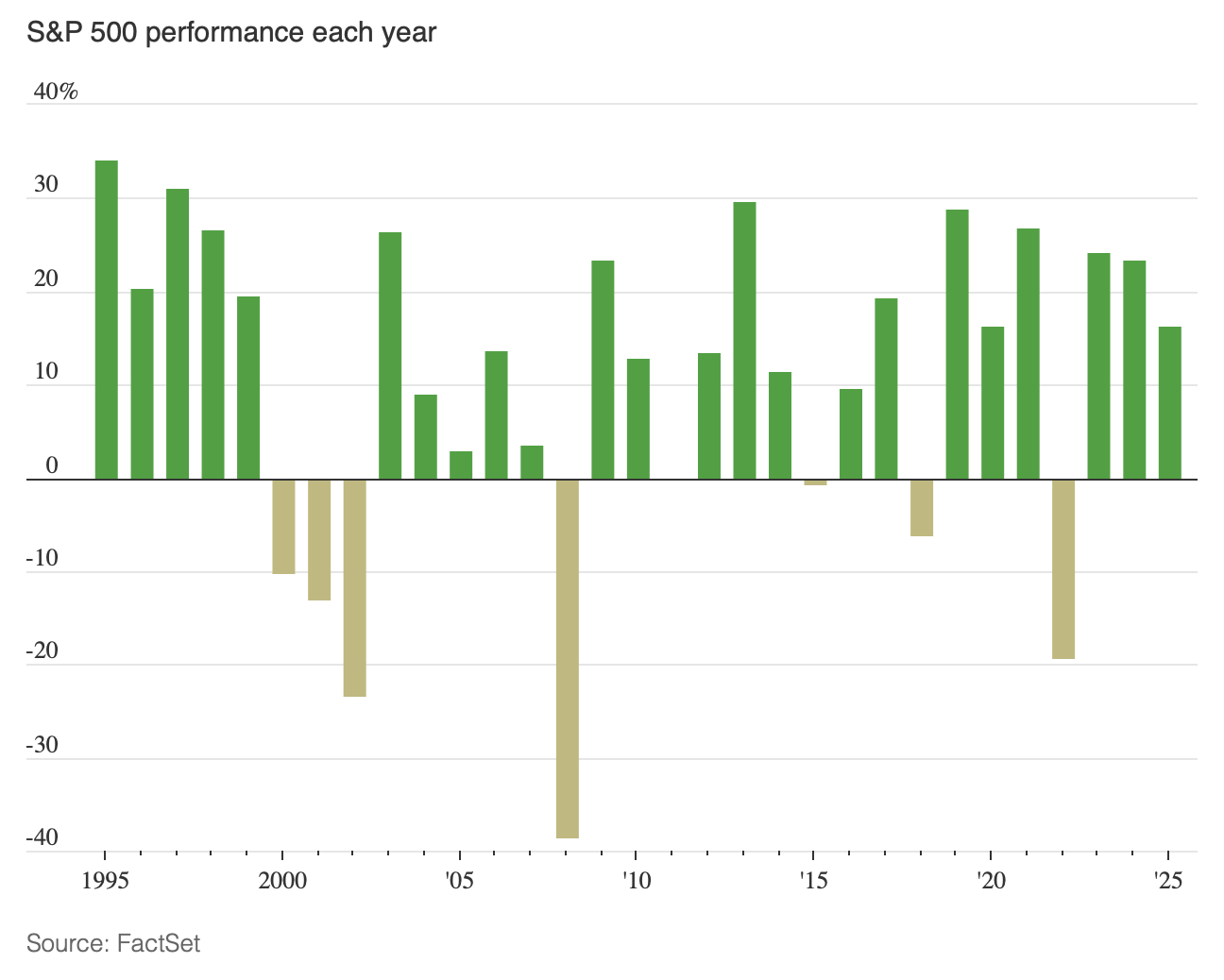
After posting double-digit percentage increases for three straight years, from 2023 through 2025, the S&P 500 and other major U.S. indexes enter year four of their rally with stretched valuations on many big stocks and a cloudier economic picture. There are enough positives to give investors and analysts hope, but some worry there isn’t enough to keep up the pace of 2025.
“We probably have an OK market, but certainly not what we’ve seen in the last couple years,” said Mark Hackett, chief market strategist at Nationwide.
The S&P 500 surged 16% last year, with a resilient economy, renewed interest-rate cuts and artificial-intelligence fervor propelling the benchmark index to 39 records. The Dow Jones Industrial Average gained 13% while the Nasdaq composite jumped 20%.
Wall Street analysts and strategists have predicted the party will continue in 2026. Bank of America expects the S&P 500 to reach 7,100 by the end of this year, a 3.7% gain from the 2025 closing level. JPMorgan Chase and Goldman Sachs expect the benchmark index to reach 7,500 and 7,600, respectively.
Their bullishness, in light of the past gains, is reason enough to be cautious, some investors said. The S&P 500 surged roughly 80% from the start of 2023 through New Year’s Eve, a torrid pace that will be hard to maintain under most circumstances, they said.
“It behooves investors to at least offer a little skepticism when there is such a broad consensus that everything will go well,” said Steve Sosnick, chief strategist at Interactive Brokers.
The current rally is getting old, at least compared with past market cycles. Should the S&P 500 rise in 2026 for a fourth-consecutive year, it would be the longest such streak since 2007, when the benchmark completed a five-year run. In the index’s history, there have only been five streaks of four or more consecutive years of gains, according to Dow Jones Market Data.
In the coming days, investors will get their next look at the economy’s health from the December jobs report. Companies will also begin reporting earnings soon, with results from big banks including JPMorgan Chase, Wells Fargo and Citigroup due in the next few weeks.
The 2025 rally swept across more than just stocks. Gold and silver had their best year since 1979, while bonds saw their best showing since 2020. A fresh wave of speculation among individual investors spawned a new class of meme stocks and helped drive options trading volumes to records again.
One expected boon for the market this year is lower interest rates. The Federal Reserve penciled in one quarter-point cut for this year, and some expect that President Trump’s pick for the next Fed chair after Jerome Powell’s term expires in May will lean more dovish. Tax cuts are also poised to boost corporate coffers.
Yet, there are also signs that prices have run up too far, too fast. The price of bitcoin finished last year below $88,000 after sliding more than 30% from its record above$126,000 set in early October. Many of the meme stocks that saw huge swings higher have come down just as quickly.
Some analysts are also concerned that the huge gains in artificial-intelligence stocks, which have fueled much of the market’s gains over the past three years, have limited room to run further. While many believe that AI will be a transformative technology for the economy, they fret that the promised returns on multibillion-dollar investments between the major AI players will be difficult to realize, potentially weighing on future gains.
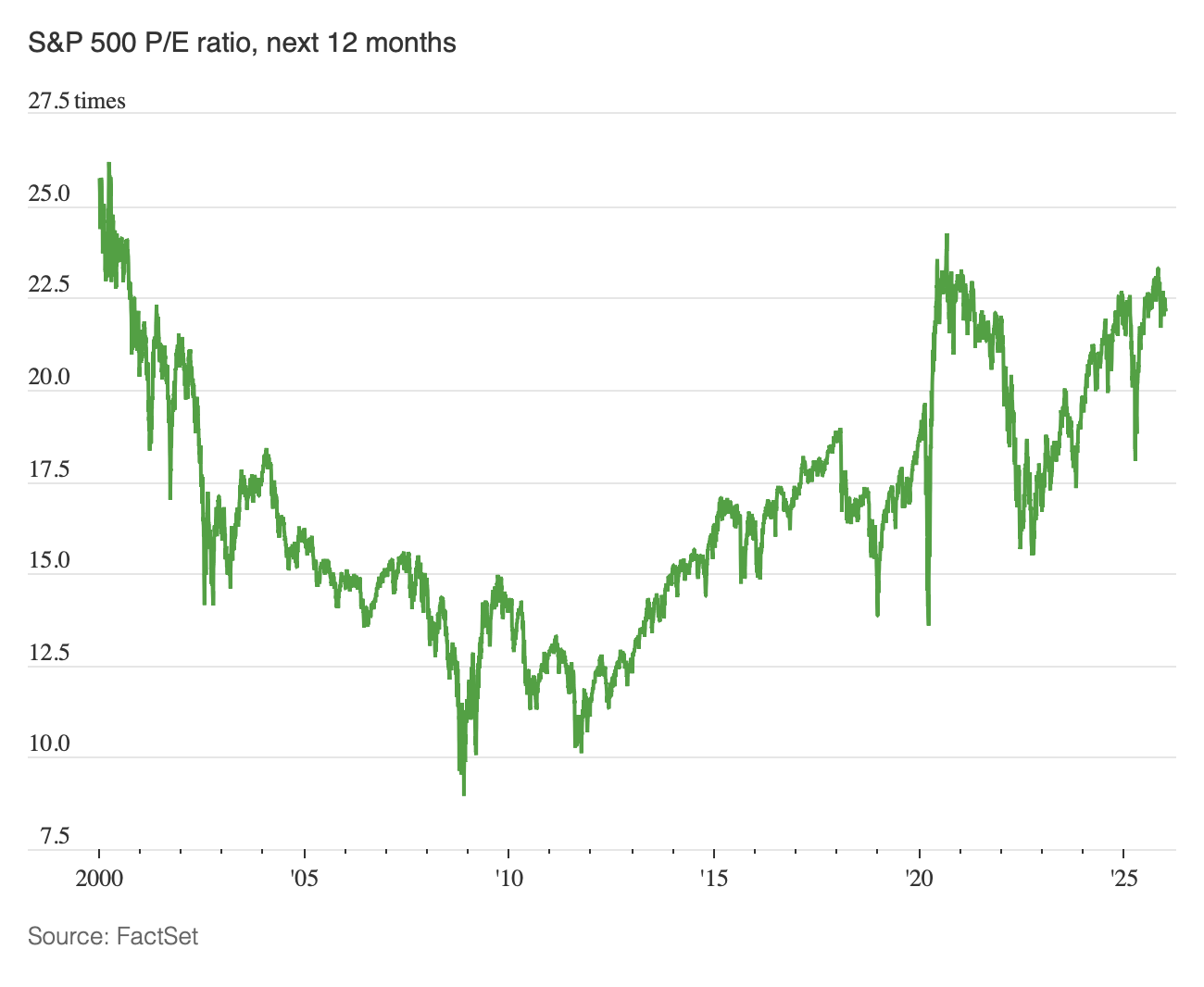
Stock valuations are looking rich, too. Companies in the S&P 500 are trading at 22 times their expected earnings over the next 12 months, above their 10-year average of 19 times. Around half of the valuation metrics for the S&P 500 tracked by Bank of America are higher than levels seen in March 2000, near when the dot-com bubble burst.
Many expect that the economy will continue to hold up and provide fresh fuel for the stock rally. The U.S. economy remained resilient last year despite Trump’s tariffs, persistent inflation and immigration shocks, with Americans continuing to spend and businesses continuing to invest mammoth amounts in data centers and other critical parts of AI infrastructure.
Corporate earnings growth is expected to remain robust. Analysts polled by FactSet expect companies in the S&P 500 to report a 15% jump in profits this year, which would mark the highest annual rate of growth since 2021.
“The base case is one in which there is sufficient momentum in the economy,” said Mark Luschini, chief investment strategist at Janney Capital Management.