


OUR QUARTERLY NEWSLETTER TO CLIENTS AND FRIENDS OF THE FIRM
FIRST QUARTER 2026
Energy Shocks & Market Resilience
War is among the most devastating forces humanity experiences. Yet history shows us that even in the shadow of conflict, society rebuilds, innovation continues, and economic progress resumes often sooner than many expect.
The first quarter of 2026 offered investors another familiar reminder: markets are noisy but resilient. Since the conflict with Iran began, growth has moderated, inflation has risen, and while recent signals suggest an end may be near, risks remain.
The most tangible risk of the current conflict involving Iran is through energy prices, which ripple across transportation, manufacturing, and consumer goods. If you’ve filled your car with gasoline recently, you’ve felt the rise in energy costs firsthand. Even so, futures markets suggest the spike in oil prices may be temporary. Contracts expiring as soon as next year are trading under $70 a barrel, down from a high of $112.95 on April 7th, indicating that market participants expect energy prices to normalize over time.1
long-term success
rarely depends
on identifying a
single winner
Despite these pressures, equity markets have recovered from their short-lived drawdown earlier this year, and many clients have been pleasantly surprised by their Q1 results. While US tech companies have ceded their spot as top performers, international and emerging markets delivered strong results and our alternative investments provided measurable diversification benefits during a period of uncertainty. This reinforces a core principle: long-term success rarely depends on identifying a single winner, but rather on maintaining exposure to many sources of return.
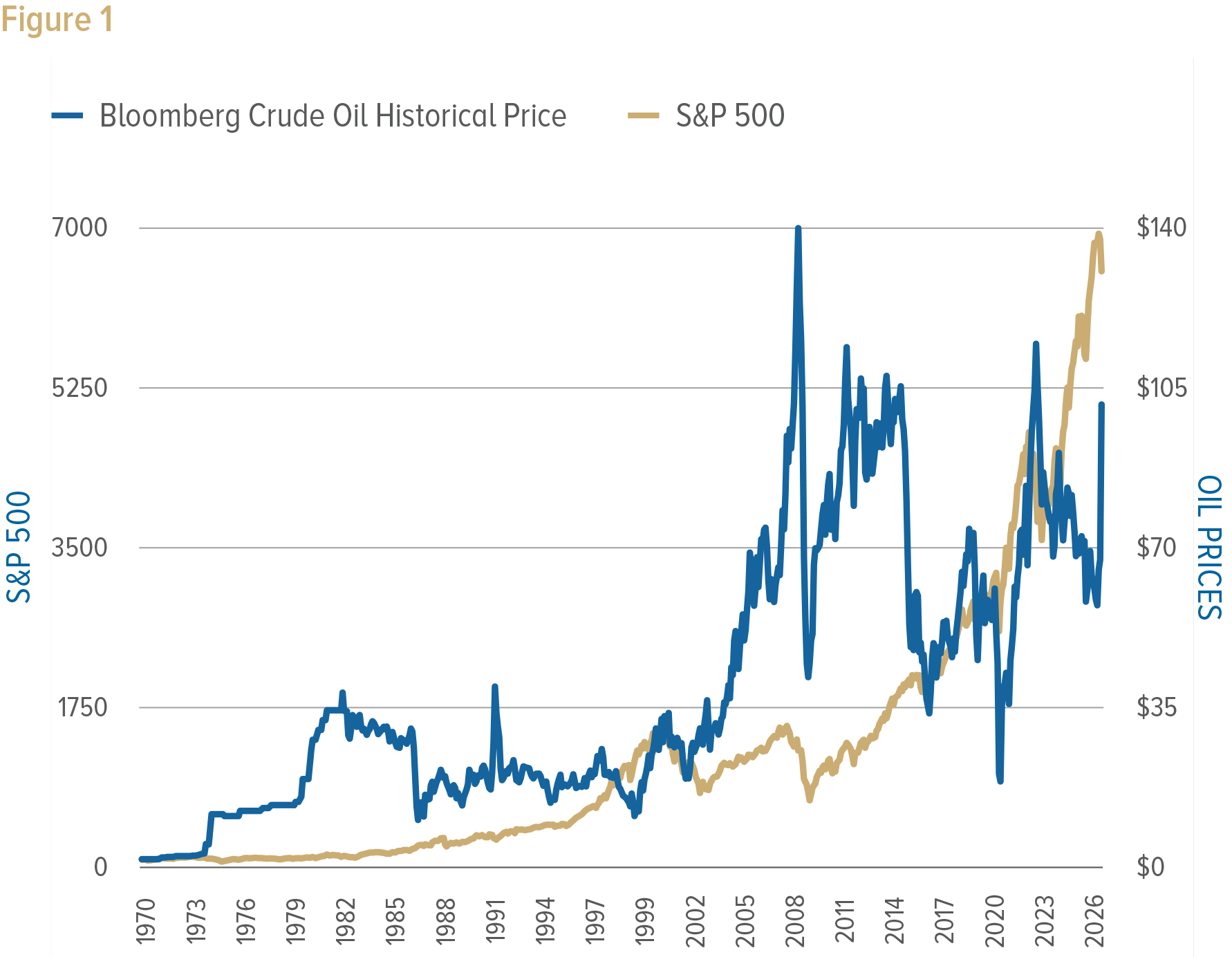
The relationship between oil prices and stock returns is less intuitive than it seems: despite repeated oil price surges over the past 50 years, the data shows no consistent pattern of weak stock returns in the periods that followed. Figure 1 illustrates this by showing the returns of the S&P 500 Index compared to the price of oil over time. Rather than being coupled to the price of oil, the stock market relies more on total economic growth.
Technology remains a key driver of that growth. Artificial intelligence is reshaping industries from healthcare to manufacturing, and the opportunity extends well beyond a handful of high-profile companies. The expansion of the broader infrastructure of data centers, semiconductors, power generation, and network capacity continues to drive growth both at home and abroad.
As we move further into 2026, the landscape appears neither euphoric nor fragile. Growth is steady, corporate earnings continue to expand, and interest rates are supportive without being artificially low. These conditions may lack drama, but they provide a durable foundation for long-term investors.
Our commitment remains unchanged: thoughtful planning and portfolio management, clear communication, and disciplined focus on the principles that have guided successful investing for generations: diversification, patience, and perspective.
PRIVATE CREDIT
VS. THE PRESS
Recent headlines have drawn comparisons between today’s private credit markets and 2008. Those comparisons may garner attention, but they aren’t supported by the facts. The current environment reflects adjustment, not crisis.
Private credit is central to the U.S. economy. Middle-market companies, the primary borrowers, number roughly 230,000 firms and employ about 40 million people, nearly one-third of all U.S. corporate employment. This is a foundational source of business investment and job creation, not a peripheral corner of finance.
Much of the concern centers on software companies, which represent about 24% of the private credit market, and their vulnerability to AI disruption.2 Yet many of these businesses operate on long-term contracts with recurring revenue, meaning any performance adjustments are likely to unfold gradually rather than suddenly.
Redemption gates, or predefined limits on investor withdrawals, have also drawn scrutiny. Rather than being warning signs, these limits are prudent risk-management tools that prevent forced asset sales and protect portfolio value for all investors. Risk in this asset class is best measured by default rates, not headlines. Current credit losses sit at approximately 2.5% per year, broadly in line with historical norms3.
Risks will always exist in investing. Although vigilance is warranted, the evidence today is clear: current default rates are far from concerning, liquidity is available, and private credit markets are functioning as designed. Rather than running for the hills, we’ll continue to closely monitor these assets and evaluate opportunities in the context of your entire portfolio.
Disclosures: Past performance is no guarantee of future results.
1: US Crude WTI Future September 2027 contract valued at $69.74 as of 4/17/26 and historical price of the contract on 4/7/26. 2: JPM IB North American Credit Research, Proskauer, Latest as of March 2026. 3: Wall Street Journal, Private Credit’s Exposure to Ailing Software Industry Is Bigger Than Advertised 3/29/26. Figure 1: For illustrative purposes only. Data sourced from Bloomberg. Chart compares the Bloomberg Crude Oil Historical Price Index to the S&P 500 Index, monthly from 1/1/70-3/31/26.
War in the Middle East
Challenges Global
Financial Stability
Markets have been broadly orderly so far—
but financial stability risks are elevated
By Tobias Adrian
Global financial markets entered 2026 from a position of strength. Asset prices rose across major markets, volatility was subdued, and financial conditions were easy by historical standards. That benign backdrop has now been tested by the war in the Middle East.
So far, markets have absorbed the shock with a degree of resilience. While the decline in asset prices has been significant, market functioning has been orderly. Nonetheless, this resilience should not be taken at face value. Rather, it reflects cycles of escalation and de‑escalation, structural improvements in the financial system, and the absence of a decisive adverse turn that would trigger sustained market drawdowns.
Repricing, orderly market functioning
Global markets reacted swiftly following the outbreak of hostilities. Equity prices declined, sovereign bond yields rose, and volatility increased across asset classes, reflecting higher energy prices and renewed inflation uncertainty. Importantly, this adjustment was reasonably orderly, without signs of acute liquidity stress or funding problems among financial institutions and investors. In fact, this price‑based absorption of shocks is a key feature of resilient markets. It facilitates risk sharing across investors and preserves price discovery critical for efficient capital allocation. So far, short‑term funding markets and core market infrastructures have helped facilitate the repricing of assets.
Financial conditions have tightened since the onset of the conflict, but they remain far from the stress levels observed during past episodes of global turmoil. Compared with earlier crises, there is still a considerable margin of safety. At the same time, the relatively modest adjustment to date also indicates that markets have not fully priced adverse scenarios.
Inflation as a transmission channel
The main channel through which the conflict has affected markets has been via inflation expectations. Higher energy prices have pushed breakeven inflation rates and yields up across advanced and emerging economies. Yield curves have flattened, with short‑term rates rising more than long‑term rates. This highlights the difficult environment facing central banks. With near‑term inflation risks having risen substantially, monetary policy must remain focused on price stability. On the other hand, the longer the war continues, the more damaging it is to economic growth and labor markets—the flattening of the yield curve, should it continue, could be a sign of this. In this environment, clear communication, credibility, institutional independence, and timely tightening when warranted are essential to anchoring expectations.
Spotlight on emerging financial vulnerabilities
Higher yields have renewed focus on public debt risks. Many advanced economies are entering this episode with elevated debt levels and limited fiscal space. Together with changes in the investor base—away from central banks and toward price‑sensitive nonbank investors—sovereign yields may respond more forcefully to inflation shocks than in the past.
Emerging markets are more sensitive to these changes. Elevated pre‑shock valuations and the growing dominance of debt portfolio flows and carry‑trade strategies have increased exposure to global risk sentiment. While resilience has improved over the past decade in many countries, vulnerabilities remain pronounced in those with high external financing needs or volatile investor bases.
Amplification mechanisms
The key financial stability risks do not lie in the initial shock itself, but in amplification channels that could turn market volatility and sell-offs into more acute stress. Elevated leverage in parts of the nonbank financial sector, increased concentration in equity markets, and historically tight credit spreads all raise the potential for abrupt forced-selling and sudden liquidity strains through margin and collateral calls.
Private credit is an important area of focus. Rapid growth in direct lending has made the sector more important to the overall economy and financial system, while opacity, valuation practices, short‑term funding backed by longer‑term assets, and rising defaults pose challenges. While these vulnerabilities have not yet been tested by an adverse shock, their presence means that the system is more exposed, even if markets have remained orderly so far.
Policy space: constrained, but differentiated
In addition to monetary policy, other key policy areas also have uneven space to act. Fiscal policy is limited by high debt and persistent deficits. By contrast, financial stability policy is less constrained. Central banks have reduced their balance sheets, freeing some capacity for asset purchases if needed, and crisis‑management frameworks and liquidity backstops are stronger than in the past. Targeted prudential measures, robust supervision, effective stress testing, and well‑designed liquidity tools can also be deployed.
Prepare, don’t predict
The experience of recent months underscores that resilience should not be inferred from the absence of stress. Elevated asset prices, intact risk‑taking incentives, and stronger amplification channels mean that risks remain skewed to the downside—even if markets have adjusted in an orderly manner so far.
The task for policymakers is therefore not to predict the next shock, but to ensure that vulnerabilities are mitigated and the system remains capable of absorbing stress without amplifying it. Amid recurring supply shocks and heightened geopolitical uncertainty, financial stability cannot be taken for granted—it must be actively protected.
This blog is based on Chapter 1 of the April 2026 Global Financial Stability Report, “Global Financial Markets Confront the War in the Middle East and Amplification Risks.”