


OUR QUARTERLY NEWSLETTER TO CLIENTS AND FRIENDS OF THE FIRM
SECOND QUARTER 2024
Portfolio Concentration & Biases
This year’s numerous all-time highs in the S&P 500 are largely driven by NVIDIA, which alone accounts for nearly one third of the index’s performance in the first half of 2024. Adding Microsoft, Amazon, Meta (Facebook), and Eli Lilly into the mix covers over half of the index’s strong performance.
While it may be tempting to invest heavily in these standout performers, concentrating your investments in a few stocks can be extremely risky. I’ve summarized a few of my favorite studies highlighting these risks in Figure 1. On the other hand diversifying your portfolio helps mitigate the risks associated with betting on one or even a few stocks.
Figure 1
STUDIES ON STOCK CONCENTRATION
Singled Out: Historical Performance
of Individual Stocks 1927-2020
By Bryan Ting and Wes Crill
Ting and Crill found that only about 20% of stocks outperformed the market over 20 years. Stocks are prone to delisting and decline even if they have performed well historically. Their study confirms that past performance does not reliably predict future success, with winners having no better chance of continued outperformance than losers.
Underperformance of Concentrated
Stock Positions 1926-2022
By Antti Petajisto
Individual stocks underperformed the market by a median of -7.9% over ten years. The stocks that were recent top performers did even worse. The study highlights that the odds of a concentrated position outperforming the market are slim, especially if the stock has performed exceptionally well recently.
The Capitalism Distribution 1983-2007
By Longboard Asset Management
Out of the top 3,000 stocks in the US, 39% lost money, and 19% saw losses exceeding 75%. Additionally, 64% underperformed the Russell 3000 Index. This highlights the inherent risk of relying heavily on a single stock: the chance of significant loss is high.
Wealth Creation in the US Public
Stock Markets 1926-2019
By Hendrik Bessembinder
This study’s findings reveal that while a few high-performing stocks generate significant market returns, nearly 60% of stocks diminish shareholder wealth. Most importantly, only 4% of stocks outperformed Treasury bills, and fewer than 1% of stocks were responsible for over half of the wealth creation. This skewed distribution means that the odds of a single stock delivering exceptional returns are slim.
Although everyone knows, and the evidence supports, that diversification is a good idea in theory, it’s worth taking a look at why it is often brushed aside in practice. There are several behavioral biases that we as human beings exhibit, and these go a long way towards explaining this departure.
1. FAMILIARITY BIAS
Investors overestimate the safety of familiar stocks, such companies that have been regularly highlighted in the press. This overconfidence often leads to underestimation of the risks involved.
2. RECENCY BIAS
This bias also plays a role, where investors are influenced by recent strong performance and project these results into the future. This can result in buying or continuing to hold onto a stock based on its past performance, even if current valuations are high and future returns are uncertain.
3. ANCHORING BIAS
When investors irrationally hold assets based on their initial purchase price, rather than evaluating the current value of the investment.
4. CONFIRMATION BIAS
This is one we’ve all heard of before, but in investing this occurs when individuals ignore negative news about a stock and only pay attention to information that supports their views.
5. HERD MENTALITY BIAS
Essentially the tendency to follow the crowd. Investors tend to feel more confident when purchasing securities that all their friends or the media are discussing. This tends to work great on the way up, but not so much on the way down.
All these biases above can combine and contribute to concentrated portfolios. In contrast, diversification is often described as the only “free lunch” in investing. By spreading investments across a range of assets and recognizing our own human biases, investors not only reduce risk but also enhance the chances of achieving better long-term returns.
NEW TAX SAVING STRATEGY
TAKES OFF
While both death and taxes remain inevitable, our new tax-saving strategy can help delay at least one. We have been using individual stock portfolios to aggressively harvest tax losses for some 20 years (the strategy has just recently made its way to the mass market under the moniker “Direct Indexing”). Our new Flex strategy, which we began to roll out at the beginning of this year, represents the latest and most advanced effort to maximize after-tax returns. Unlike previous strategies that involve swapping stocks when they fall below their original cost basis, Flex takes tax loss harvesting to a whole new level.
By using margin and shorting (which may sound intimidating), we buy favorable stocks and short less favorable stocks. Definitionally, we benefit when stocks we’re long go up in price and when stocks we’re short go down in price. Thus, we’re able to capture losses whether stocks go up or down and later use them to offset capital gains which reduces our ultimate tax bill.
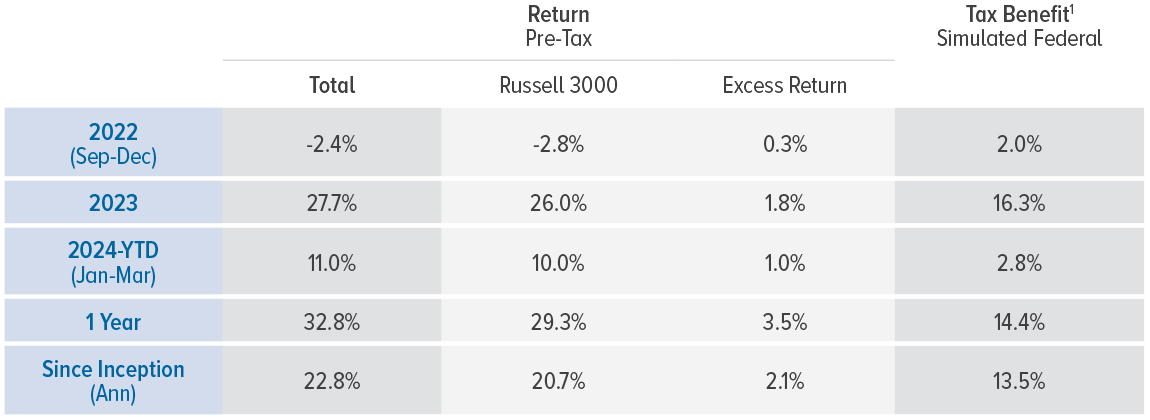
Figure 2 compares the live results of this strategy to the target US market return of the Russell 3000 and even shows the tax benefits. Results will vary, but Flex can significantly benefit clients with liquidity events (think the sale of a company or property), minimize portfolio capital gains taxes, and enhance the effectiveness of charitable giving. Although this strategy is not appropriate for all clients, in the right situation it’s designed to significantly reduce yearly tax bills.
Figure 2
DESIGNED TO PERFORM BEFORE AND AFTER TAXES
Flex 145 All Cap Equity Composite Net of Fee Performance, as of March 31, 2024

Tax Smart Strategies for Account Withdrawals
Understanding the best way to tap your IRAs and other accounts
can help you preserve your savings and lower your tax bill.
By Sandra Block
June 19, 2024
One of the upsides of retirement is that for the first time in years, you have control over your time. If you want to spend the afternoon watching Bonanza reruns, well, no one is going to stop you.
Retirement also gives you more command over your money. While you’re working, you have limited control over how often or how much you’re paid, which limits your ability to lower your taxes. But if you’re drawing retirement income from a combination of different types of accounts, you can control not only the amount you withdraw but also the sources of those withdrawals — and that could have a big impact on your taxes now and in the future.
Conventional wisdom has long held that retirees should take money from their taxable brokerage accounts first, followed by traditional IRAs and other tax-deferred accounts, with Roth IRAs and Roth 401(k)s coming last. The logic behind this strategy is that it gives your tax-advantaged accounts more time to grow. Money in tax-deferred accounts isn’t taxed until you take withdrawals, and withdrawals from a Roth are tax-free as long as you’re 59 1/2 or older and have owned the account for at least five years.
But in recent years, some retirement experts have questioned whether this is the most effective way to lower taxes on your retirement income and preserve your savings for your later years. Postponing withdrawals from your tax-deferred accounts could eventually lead to large, taxable required minimum distributions (RMDs currently start at age 73).
And since those withdrawals are taxed at ordinary income tax rates, which range from 10% to 37%, large distributions could push you into a higher tax bracket and trigger Medicare high-income surcharges, says Wade Pfau, professor of retirement income at the American College of Financial Services and author of Retirement Planning Guidebook: Navigating the Important Decisions for Retirement Success.
Roger Young, a certified financial planner and thought leadership director for T. Rowe Price, agrees. The conventional withdrawal sequence “bunches a lot of taxable income in the middle period, where pretty much all of your income is taxable,” he says.
Retirees who have a mix of accounts could generate income more tax-efficiently by withdrawing from a combination of taxable and tax-deferred accounts, as well as making strategic conversions to Roth accounts, while remaining in a low tax bracket, Pfau says. One way to accomplish this goal is to withdraw enough from your taxable accounts to cover spending needs and income taxes. After that, calculate how much you can withdraw from your tax-deferred accounts and convert to a Roth while remaining within your desired tax bracket.
In 2024, a married couple who fi les jointly can have up to $94,300 in taxable income and fall within the 12% tax bracket; for singles, the cutoff is $47,150. These thresholds are close to the points at which taxpayers can qualify for a 0% tax rate on long- term capital gains and qualified dividends (assets held for more than a year are subject to rates for long-term gains). In 2024, the 0% rate applies to capital gains and qualified dividends for singles with taxable income up to $47,025 and married couples with joint taxable income up to $94,050.

Taking strategic withdrawals from a mix of taxable and tax-deferred accounts while remaining within these thresholds provides two benefits. You’ll pay taxes on your tax-deferred withdrawals at a low rate and reduce the size of those accounts, which will shrink your RMDs. You may also qualify for the 0% capital gains rate on income from your taxable accounts.
Meanwhile, you’ll pay taxes on conversions from a traditional IRA to a Roth at a low rate, which will increase the amount of tax-free income you’ll have available in later years. Ideally, you should use assets from your brokerage or other taxable accounts to pay taxes on the conversions, Pfau says.
If you postpone Roth conversions until you’ve depleted those accounts, you may have to use funds from your IRA to pay the tax bill. That’s not the end of the world, he says, because you’ll still benefit from having future tax-free income (and if you’re 59 1/2 or older, you won’t pay a 10% early-withdrawal penalty on those distributions). But it reduces the amount of money you’ll be able to invest in the Roth.
Taxes on Social Security
Converting funds in your traditional IRAs to a Roth can help reduce your taxable income later in life because, ideally, a large percentage of your withdrawals will come from your Roth. This will help you avoid what Pfau calls the Social Security “tax torpedo,” which occurs when up to 85% of your benefits are taxed.
The formula for calculating tax on Social Security benefits is based on what Social Security defines as your provisional income (sometimes referred to as combined income), which is based on half of your Social Security benefits, plus other sources that contribute to your adjusted gross income, including withdrawals from traditional tax-deferred accounts; dividends, interest and capital gains from taxable investment accounts; and interest from municipal bonds.
If your provisional income ranges from $25,000 to $34,000 for single filers, or $32,000 to $44,000 for joint filers, up to 50% of your benefits will be taxable. If your provisional income is more than $34,000, or $44,000 for joint filers, up to 85% of your benefits will be taxable.
These thresholds aren’t adjusted for inflation, which means the percentage of retirees who pay taxes on their benefits has increased dramatically since the tax was signed into law more than 30 years ago. More than half of retirees pay taxes on a portion of their Social Security benefits, according to the Center for Retirement Research at Boston College.
Withdrawals from a Roth aren’t included in your provisional income, so increasing the size of your Roth accounts through strategic conversions can help lower taxes on your benefits. If you’re able to delay filing for Social Security until age 70, which will maximize the amount of your monthly payouts, you’ll have more time to reduce the size of your tax-deferred accounts and convert some of your funds to a Roth, T. Rowe Price’s Young says.
Charitable Giving
If you plan to give funds in your tax-deferred accounts to charity, you may not need to accelerate certain withdrawals as much as you would otherwise.
One strategy that can reduce your RMDs — and your tax bill — is to make qualified charitable distributions (QCDs), which are donations made directly from your IRA to qualified charities. You can make a QCD as early as age 70 1/2, but when you reach the age at which you’re required to take distributions, the charitable distribution will count toward your RMD.
Although a QCD isn’t deductible, it will reduce your adjusted gross income, which will in turn reduce the provisional income used to calculate taxes on your Social Security benefits. In 2024, you can donate up to $105,000 directly from your IRA to a qualified charity.
Alternatively, if you’re worried about giving away money you may need for long-term care or other late-in-life expenses, you can leave funds in your IRA to charity. The charity won’t have to pay taxes on the money, and you can leave more tax-friendly assets to your heirs. But this won’t absolve you from taking RMDs and paying taxes on those withdrawals while you’re still alive.
Your Estate and Taxes
Shifting more of your assets to Roth accounts won’t just lower your taxes in your later years. It could also benefit your heirs if they end up inheriting money in those accounts.
Under the SECURE Act of 2019, most adult children and other non-spouse heirs who inherit a traditional IRA or other tax- deferred account from an owner who died on or after January 1, 2020, have two options: Take a lump sum and pay taxes on the entire amount, or transfer it to an inherited IRA and deplete the account within 10 years of the death of the original owner.
Depending on whether the original owner was taking RMDs when he or she died, the heirs may also have to take yearly withdrawals based on their life expectancy, which could mean paying taxes during their highest-earning years. (Spouses still have the option of rolling inherited IRAs into their own IRAs.) Because of confusion about the rules, the IRS has waived the RMD requirement for non-spouse heirs the past few years and is doing so again for 2024.
The 10-year rule also applies to inherited Roth IRAs, but heirs aren’t required to pay taxes on the withdrawals or to take RMDs. That gives them plenty of flexibility, including the ability to wait until year 10 to deplete the account, thereby taking advantage of more than a decade of tax-free growth.
If you have a large brokerage account with significant appreciation, you may want to consider preserving some of those assets for your heirs. Under current tax law, inherited investments receive a “step-up” in their cost basis to the current fair market value when the original owner dies. If your heirs turn around and sell those investments right away, they won’t pay tax on any gains, no matter how much the investments have increased in value since you purchased them.
Note: This item first appeared in Kiplinger Personal Finance Magazine, a monthly, trustworthy source of advice and guidance.
Disclosures: Past performance is no guarantee of future results.
1 The tax benefit liability is calculated using a pre-liquidation calculation methodology reflecting the impact of realized tax outcomes. It is calculated as the difference between the geometrically annualized monthly after-tax returns and similarly calculated pre-tax returns reflecting an assumed monthly reinvestment of tax benefits (liabilities) into (out of) the portfolio. The calculation methodology only considers federal tax rates (assumes -40.8% for short term capital gains/losses and ordinary income/expense and -23.8% for long-term capital gains/losses and qualified divided income) and excludes the potential state tax benefit (liability). Potential Federal tax benefit and after-tax returns are for illustrative purposes only and may not reflect all taxes that an investor would incur.
Figure 2 Sources: AQR, Bloomberg. XpressFeed, Barra. Performance data is estimated and subject to change. Past performance is not a guarantee of future performance. Unaudited net returns shown in USD. Flex 145 All Cap Equity – formerly Flexible SMA – Beta 1 Low TE US All Cap Equity – formerly Enhanced Direct Indexing – Tax Aware US All Cap Equity Composite net performance calculated based on 0.4% model mgmt. fee, per annum. Other discretionary portfolios that trade similar securities and/or strategies as those portfolios included in this composite, but do not meet this composite’s strategy criteria, are excluded from this composite and reside in one or more separate composites, which are available upon request. The GIPS Composite Reports for FLex 145 All Cap Equity Composite can be found in Disclosures.