


OUR QUARTERLY NEWSLETTER TO CLIENTS AND FRIENDS OF THE FIRM
THIRD QUARTER 2024
Investment Implications of Falling Interest Rates
While history can’t predict the future, it can provide valuable insights into the possible outcomes. With the Federal Reserve’s recent interest rate cuts making waves in the markets, it’s wise to examine how different types of investments have performed in similar past scenarios.
BONDS
Bond prices tend to increase following interest rate cuts from the Fed. When rates decrease, newer bonds that are issued will offer lower returns than older ones, making existing bonds more desirable. As demand for these Investment Implications of Falling Interest Rates older bonds and their higher returns rises, their prices increase.
This is an extremely simplified view, and factors such as recessions or other macroeconomic factors can complicate things. On the whole, however, we generally expect bonds to perform well in the face of falling interest rates and poorly as those rates rise.
STOCKS
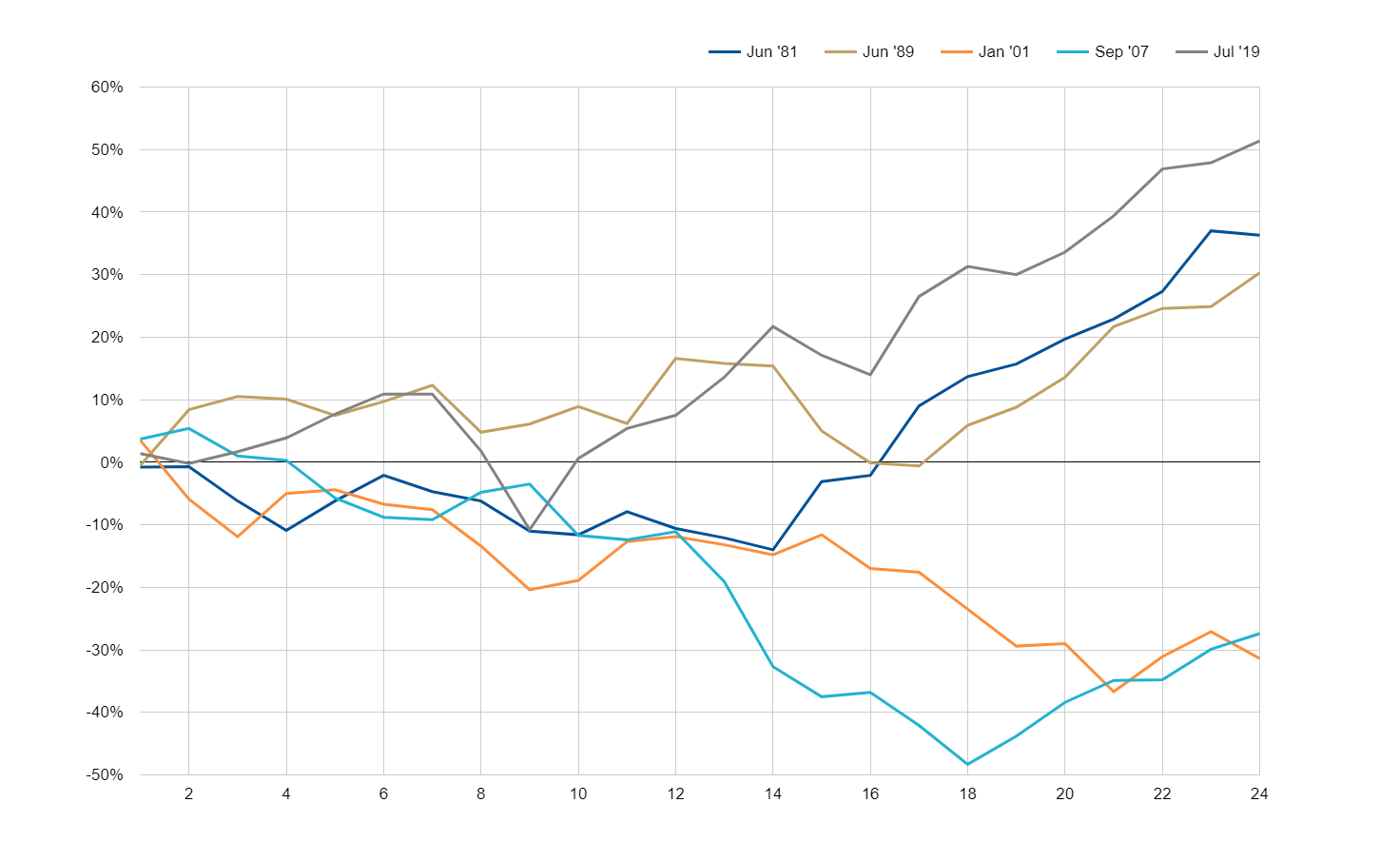
Historical data shows that US stocks, as tracked by the S&P 500, have often performed well in the months following the Fed’s first rate cut. However, this depends on the health of the economy as a whole. Figure 1 shows examples of both scenarios, illustrating the performance of the US stock market following Fed rate cuts.
The goal of rate cuts is to boost or sustain economic growth by lowering the price of borrowing and encouraging spending. Oftentimes this results in a boost to the stock market, however, as we saw after the dot-com bubble and the 2008 financial crisis, that’s far from a certain outcome.
Figure 1
S&P 500 RETURNS
24 months following the start of Fed rate cutting cycles
MONTHS FOLLOWING THE FIRST CUT
CASH
While cash is typically regarded as the safest type of investment, holding cash in a falling interest rate environment can lead to significant opportunity costs. When interest rates are low or declining, the real returns on cash, adjusted for inflation, can often be negative, which diminishes purchasing power over time.
As cash returns diminish, many investors and savers may find it necessary to seek higher returns by moving into riskier assets. This shift often involves investing in securities like bonds and stocks to help meet their financial objectives.
REAL ESTATE
Lower interest rates generally benefit the real estate market by reducing borrowing costs for both homeowners and developers. With cheaper financing, demand for residential and commercial properties typically increases, which drives up property values. For property investors, these lower costs can lead to higher profits.
However, falling rates can be a double-edged sword for real estate investors. While lower rates can boost property values and income, they can also lead to increased competition, as more buyers are drawn to the market.
FINAL THOUGHTS
The Federal Reserve’s interest rate cuts have broad effects across financial markets. Typically, falling rates benefit bonds and real estate while also creating opportunities in the stock market, especially for small-cap companies and cyclical industries. However, rate cuts often coincide with periods of uncertainty and volatility. To manage these fluctuations, investors should focus on diversification and long-term strategies that mitigate risks and capitalize on the opportunities present in a low-rate environment.
THE BENEFITS OF
INTERNATIONAL DIVERSIFICATION
Investing in stock markets across the globe offers exposure to a broader range of economies, industries, and sectors than are found in the US market alone. As the saying goes, however, there’s no such thing as a free lunch. The diversification that’s provided by investing internationally often helps over the long term, but there’s no guarantee that these benefits will materialize in any specific period.
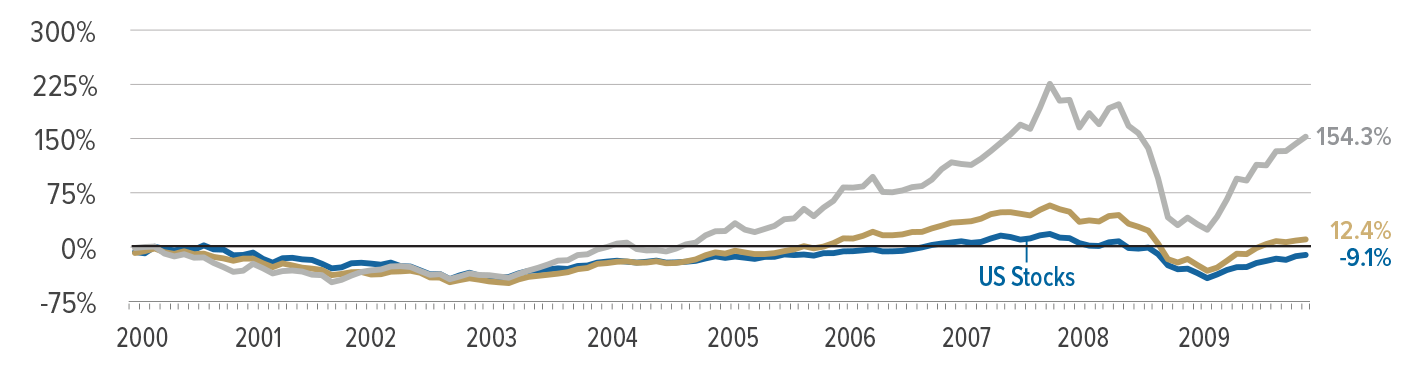
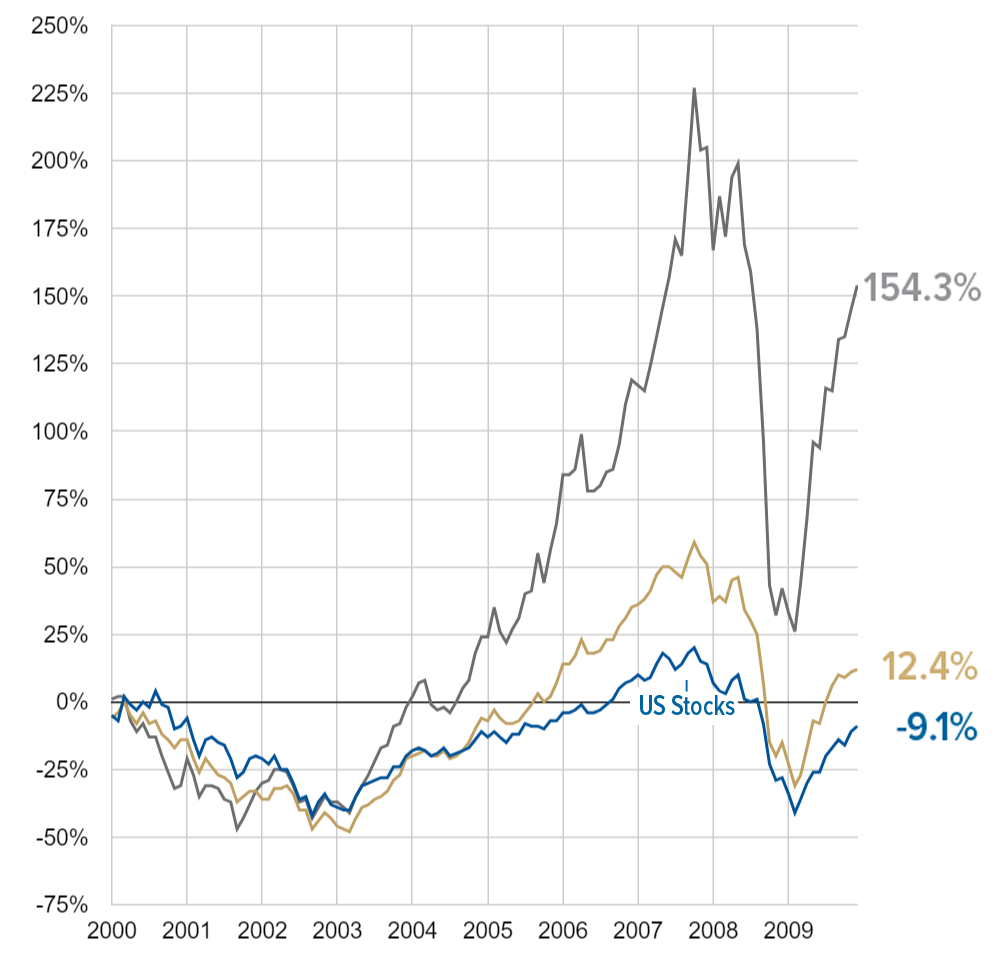
A striking example of a period of time when international diversification helped tremendously was during what is often called “the lost decade” for US equities. Pictured in Figure 2, US stocks generated virtually no returns during this ten year stretch from 2000 through 2009, while international markets delivered solid gains. A portfolio consisting only of domestic US equities during this time period would’ve suffered heavily.
In addition to the diversification provided by investing in the largest international developed countries, emerging markets offer access to fast-growing economies that tend to have lower correlations with the US market. Although emerging markets can be more volatile, they also have the potential for higher returns, which, when combined with US and international developed stocks, can help reduce overall portfolio risk.
These diversification benefits can come with a price tag from time to time, however. For the ten years ending September 30th, the US has outperformed International Developed and Emerging Markets indices. Much of this underperformance can be attributed to the dominance of US mega-cap technology stocks, such as the Magnificent 7, which have driven much of the US market’s growth.
Despite the recent lag in International and Emerging Market stock performance, they remain vital components of a well-diversified portfolio. By maintaining exposure to a broad range of markets, investors can better navigate periods of US market underperformance and benefit from the growth of economies outside the US.
Figure 2
THE LOST DECADE
January 2000-December 2009

‘Uncertainty is underrated’:
Here’s the real reason markets reward
those who stick around
By David Booth
June 24, 2024
David Booth is the founder and chairman of Dimensional Fund Advisors. This article is not intended as investment advice.
Given all that is going on in the world, investors have questions. Will the Federal Reserve cut interest rates, and if so, by how much? Who will win the U.S. presidential election, and will it impact markets? How will global events affect my family and finances? A lot remains uncertain, which can naturally make investors uneasy.
For many people, uncertainty is something to avoid or at least mitigate. People often talk more about the downside to uncertainty than its upside. There’s even a term, loss aversion, that reflects how a loss can feel more painful than a gain of an equal amount can feel rewarding.
However, I have a different view: Uncertainty is underrated. Without it, there would be no surprises, no joy in watching sports, and no 10% average annualized return on the stock market over the past century.
All investments involve risk—there is no guarantee of success. Investors can be rewarded for taking on the risk of not knowing exactly how things will play out. If there was no uncertainty, returns would be predictable and there would be no difference between putting your money in a savings account and investing it in the stock market.
Th ink back to the beginning of the pandemic. At the end of March 2020, the S&P 500 Index was down nearly 20% for the year. Yet investors who stayed in the market were rewarded. At the end of 2020, the S&P 500 Index was up 18.4% for the year, a 38% turnaround from its March lows. March 2020 was a scary time for almost everyone. No one knew what was going to happen. Yet even in those dark moments, I had faith in human ingenuity. When people are met with challenges, they are resilient and work to solve them. Companies are no different. Investing in the stock market means investing in the power of human ingenuity to adapt and innovate.
Because of uncertainty, life is one cost benefit analysis aft er another, and we have no choice but to manage risk. At the extremes, some people may try to completely ignore risk, while others might try to eliminate it. Most of us fall somewhere in the middle.
We manage risk with our health, work, family, and just about every other aspect of our lives—including investing—because while few things are certain, we still have to make decisions big and small. For example, we can’t control the weather, but we can carry an umbrella if it looks like it might rain. And while we can’t predict stock market returns, we can manage the risk in our investment portfolios.
What to avoid
One way of managing risk is to eliminate some of the things you shouldn’t do. When you want to improve your health, you might eliminate fried foods, soda, and sweets from your diet, which can increase your chance of a healthier outcome. It’s the same with investing. Eliminate bad habits, like attempting to predict the unpredictable by trying to time the market or pick winning stocks.
Think of everything that has happened in the past 25 years, including:
- The dot-com bubble.
- 9/11.
- The Global Financial Crisis
and Great Recession. - The COVID-19 pandemic.
It would be natural to want to time when to exit and re-enter the market. To put the implications of doing so into perspective, consider a hypothetical $1,000 investment in the Russell 3000 Index made at the beginning of 1999. This turns into $6,449 for the 25 years ending Dec. 31, 2023. Over that same period, if you missed the Russell 3000’s best week, which ended Nov. 28, 2008, the value shrinks to $5,382. Miss the three best months, which ended Jun. 22, 2020, and the total return dwindles to $4,546. See what I mean?
What to do
Positive ways of dealing with risk can help you potentially capture the benefits of what scientific research has shown us. With health, that means exercising more, getting regular checkups, and eating more fruits and vegetables. With investing, that means ensuring our portfolios are diversified across regions and asset classes. While it doesn’t guarantee making a profit or averting a loss, diversification allows us to reduce our risk while potentially capturing the returns of the market.
Since we know risk is unavoidable—and it’s the source of investment returns—you want to find the amount of risk that is right for you. For example, Treasury bills are considered a relatively safe investing asset whose prices don’t fluctuate as much as stock prices. However, Treasurys have provided, on average, a lower return than the stock market. Those tradeoffs can be weighed against your specific needs and preferences, and it’s always good to be prepared for a range of outcomes. The more committed you are to a philosophy and a plan you can count on when you are experiencing the ups and downs of uncertainty, the more likely you are to succeed as a long-term investor.
You are already better at this than you think.
You know more about investing than you think you do, because investing is all about risk and reward, just like every other part of your life. In investing and in life, some years are better than others, but the important thing is to be able to persevere so you’re ready for what comes next. That’s why I see uncertainty as a positive force and have faith in the ability of people to find better ways to manage risk. I’ve worked with thousands of investors during my five decades in finance and seen how, when they manage risk better, they live a better life. Instead of trying to predict your future, plan, adapt, and figure out the most sensible solutions for you.
You may not only be underestimating uncertainty—you may also be underestimating the positive impact of embracing it.
Disclosures: Past performance is no guarantee of future results. Exhibits are for illustrative purposes only.
Figure 1: S&P 500 returns begin using the month of returns listed and continue for 24 consecutive months.
Figure 2: Emerging Market Stocks = MSCI Emerging Markets Index (net div.), International Developed Stocks = MSCI EAFE Index (net div.), US Stocks = S&P 500 Index