


OUR QUARTERLY NEWSLETTER TO CLIENTS AND FRIENDS OF THE FIRM
FIRST QUARTER 2025
Embracing Uncertainty
Last October we sent out a flyer titled “Uncertainty is Underrated,” written by investment legend David Booth. In it, he emphasized that uncertainty should be embraced as the very reason we earn returns on our investments. Without risk, we’d have no reward. With the global stock market in a period of upheaval, we believe it’s essential to revisit the importance of portfolio diversification that serves to balance both sides of the risk reward equation.
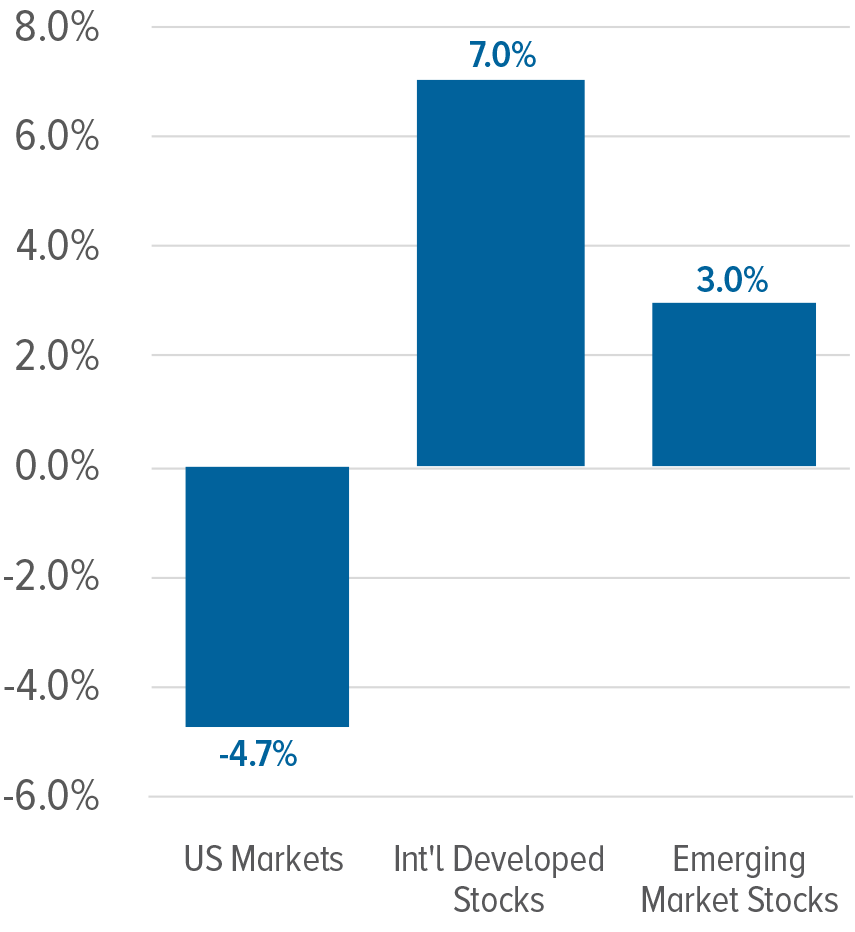
As displayed in Figure 1, the first quarter of this year has been markedly different for US markets versus those abroad. International equities are (so far) outperforming domestic equities by a wide margin. Time will tell whether this trend continues into the future and for how long, but let’s take a look at some of the reasons for this performance disparity and how our portfolios are designed to adapt regardless of which asset class leads the charge.
Economically, the U.S. pivot toward new tariffs and protectionist trade policy marks a notable departure from the era of global free trade. This shift introduces new pressure points for global supply chains and inflation. We’ve prepared for times like these by emphasizing both international diversification and targeting alternative investments in assets that have historically performed well during volatile periods. Both are designed to preserve purchasing power and generate returns in a changing macroeconomic climate.
Geopolitically, the United States is stepping back from traditional roles in international military engagement and foreign aid, creating new risks and power vacuums in global affairs. Our portfolios’ broad international diversification, commitment to private assets, and exposure to fixed and floating rate bonds similarly help protect against these changes. By allocating across a wide range of global markets and regions, we aim to reduce exposure to any single country’s policy decisions and enhance resilience in the face of geopolitical volatility.
Figure 1
GLOBAL STOCK MARKET RETURNS
First Quarter 2025
Technologically, artificial intelligence is revolutionizing how businesses operate and compete. Rather than viewing this as a disruption, we see it as a powerful long-term opportunity. Our investment strategy includes exposure to all aspects of the AI ecosystem, from the leading technology firms driving innovation to the infrastructure, hardware, and energy sources powering this transformation. This balanced approach ensures our clients are positioned to benefit from AI’s growth while managing the risks that come with any major shift.
Why Private Equity
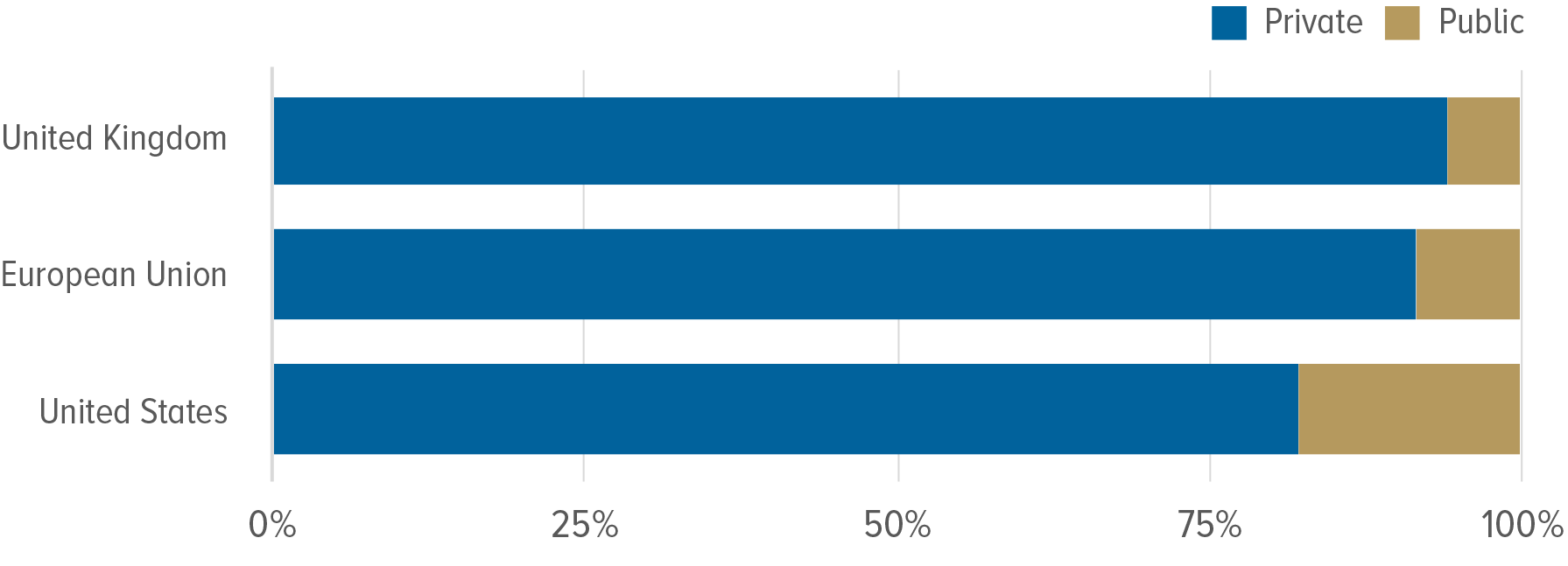
Over the last few decades, the investment landscape has changed dramatically—and one of the most significant shifts has been the shrinking number of public companies. According to the US Census Bureau, the number of publicly listed U.S. stocks fell 24% from 1996 to 2020 while at the same time, the number of private companies surged 46%. Today, as shown in Figure 2, for every public company there are dozens of private businesses operating across industries and geographies. In short, if you want to truly “own the economy,” you need to own private equity.
The forces keeping companies from going public vary but anecdotal evidence points to greater control for the founders, less regulatory burden, lower legal and other costs, and more of an ability to pursue long-term goals. These companies range from early-stage startups to mature firms undergoing ownership transitions. However, for most investors, gaining access to this market has historically been a challenge.
Figure 2
MOST COMPANIES IN THE US, EU, AND UK ARE PRIVATE
Percent of GDP, Public vs Private companies with revenue greater than $100 million
For years, the only way to invest in private equity was through traditional drawdown funds, which are complex structures typically used by large institutions. These funds required investors to commit capital up front and wait for it to be “called” over several years as opportunities arose. Returns could take a decade or more to fully realize, and minimum investment sizes were often in the millions of dollars. For all but the ultra-wealthy or institutional investors, private equity was out of reach.
That’s changing. A new generation of investment vehicles such as interval or evergreen funds has made private equity far more accessible. These structures allow individual investors to access professionally managed portfolios of private companies with lower minimums, simplified reporting, and greater diversification. While these vehicles are not as liquid as public investments, this lesser liquidity can actually be an advantage.
Academic research supports the existence of an illiquidity premium, or the additional return investors can expect to earn for owning investments with limited liquidity. This premium, combined with the lower realized volatility of private investments, has been a key contributor to private equity’s historical outperformance over public market investments.1 This makes them unsuitable for money that may be needed in the short term, but entirely appropriate as part of a long-term investment strategy.
As always, we approach private equity with the same discipline and due diligence we apply to every part of your portfolio. We believe that thoughtful allocation to private markets, balanced with the need for liquidity, risk tolerance, and long-term goals, can meaningfully enhance investment outcomes over time.

Tariffs Explained:
What They Do, Why They Matter, and Who They Impact

By Hillary Chabot
February 20, 2025
As talk of tariffs, global trading, and domestic industry dominate the headlines, we asked Babson College Associate Professor of Economics Joshua Stillwagon to help break down the basics behind this international trade tactic—what are tariffs, why are they implemented, and who do they impact?
What Are Tariffs?
“Tariffs are basically a tax on imported goods,” Stillwagon said. Tariffs can take various forms, such as a percentage of the imported goods’ value or a fixed fee per unit. While tariffs have been used for centuries, their effectiveness and economic consequences remain debated among economists and policymakers.
“Although economists are generally negative on tariffs, targeted tariffs for certain consumer products could be rational in the short term to prevent ‘dumping’ by other countries, which may threaten the existence of our domestic industry,” Stillwagon explained. Dumping occurs when a company sells a product in another country at a lower price than in its home market.
Why Implement Tariffs?
Governments impose tariffs for multiple reasons, said Stillwagon, who also serves as chair of Babson’s Economic Division. The primary motivations include:
PROTECTING DOMESTIC INDUSTRIES
One of the most cited reasons for implementing tariffs is to encourage domestic production by making imported goods more expensive. This can increase demand for locally produced alternatives, boosting profits and growth in the protected industry, at a cost to consumers.
Stillwagon noted that their effectiveness depends on how they are structured.
“If you want to boost production in the U.S., it’s better to have a more targeted approach,” Stillwagon cautioned. “Broad tariffs on essential materials like steel and aluminum increase costs for numerous industries, which would ultimately harm economic growth.
GENERATING GOVERNMENT REVENUE
Tariffs can serve as a source of income for the government, as companies importing goods must pay taxes upon entry. However, if tariffs significantly reduce imports, the revenue generated from them may diminish over time.
TRADE NEGOTIATION LEVERAGE
Tariffs can be used as a bargaining tool to encourage foreign governments to reduce their own tariffs or eliminate unfair trade practices, such as subsidies that allow foreign industries to sell products at artificially low prices in global markets.
“The best argument for our tariffs is to use them as leverage to get other countries to remove their own tariffs or unfair trade practices,” Stillwagon said.
Who Do Tariffs Impact?
While tariffs are designed to protect domestic industries, their effects can be widespread, Stillwagon said. The key groups affected by tariffs include:
DOMESTIC COMPANIES
Competition from imports can hurt domestic companies, leading to layoffs or shipping work overseas to cut costs. The recent 25% tariff imposed on foreign steel and aluminum will help U.S. steel and aluminum
industries, for example.
INFANT INDUSTRIES
This type of tariff helps to foster growth in new or young industries “until they are more established and viable in the face of international competition,” Stillwagon said. For example, a country that imports cars might impose tariffs while they create a domestic auto industry.
IMPORTING FIRMS AND INDUSTRIES
Companies that rely on foreign materials or components face increased costs due to tariffs. For example, U.S. businesses that source steel, aluminum, or auto parts from abroad must pay additional taxes when these goods cross the border.
“Tariffs on ‘upstream inputs’ like steel and aluminum will raise production costs for all the industries that need those materials,” Stillwagon said. “This will have some effect on raising inflation and reducing GDP growth compared to otherwise.”
CONSUMERS
As importing businesses pass on tariff-related costs, consumers often experience higher prices on everyday goods. This is especially true for essential items that are perishable or can’t be substituted, such as food and fuel.
Retaliatory Tariffs and Economic Uncertainty
When a country imposes tariffs, affected trading partners may respond with their own tariffs on exported goods. In 2018, China, Canada and the EU responded by targeting politically-important sectors like American agricultural products, impacting U.S. farmers and food producers. Retaliatory tariffs can shrink export markets, leading to lower sales and potential job losses in affected industries, Stillwagon said.
Another consequence of the tariffs is heightened economic uncertainty, which may cause businesses to delay investments and expansion.
“Economic uncertainty discourages business investments,” Stillwagon noted. “Recent GDP data already show weak investment as a drag on growth. Without clear trade policies, companies may delay expansion.”
Disclosures: Past performance is no guarantee of future results.
1 Cornel, McDermott, & Win. Blackrock, August 2024. “On the Historical Outperformance of Private Equity”
Exhibits are for illustrative purposes only.
Figure 1: Data from 1/1/25-3/31/25. US Stocks = Russell 3000 Index, Int’l Developed Stocks = MSCI EAFE Index, Emerging Market Stocks = MSCI EM Index.
Figure 2: Data sourced from S&P Capital IQ and BlackRock as of February 24, 2025.