


OUR QUARTERLY NEWSLETTER TO CLIENTS AND FRIENDS OF THE FIRM
SECOND QUARTER 2025
Short-Term International Success, Long-Term Global Balance
It’s mid 2025, and the world’s markets have flipped a long-standing script. For years, US equities led the global charge – especially the tech giants. But this year, that dominance has paused. Through the first half of the year, international stocks have surged roughly 18.5%, while the S&P 500 sits at a 6% gain.1 That divergence recalls past moments when leadership shifted from the US to Europe, Japan, or emerging markets – and signals we might be living through another such inflection.
The most obvious catalyst has been the US dollar. The first half of 2025 saw the steepest drop in the dollar since 1973, which inversely means foreign currencies have strengthened considerably.2 These stronger foreign currencies enhance international stock returns, explaining much of the difference across the globe so far this year.
There are deeper reasons behind this shift. In contrast with our Federal Reserve’s current positioning where rates have been held steady, central banks beyond the US have begun signaling rate cuts. Combined with fiscal stimulus – like Germany’s €500 billion infrastructure package and ramped-up defense spending – this has led to stronger earnings growth abroad.
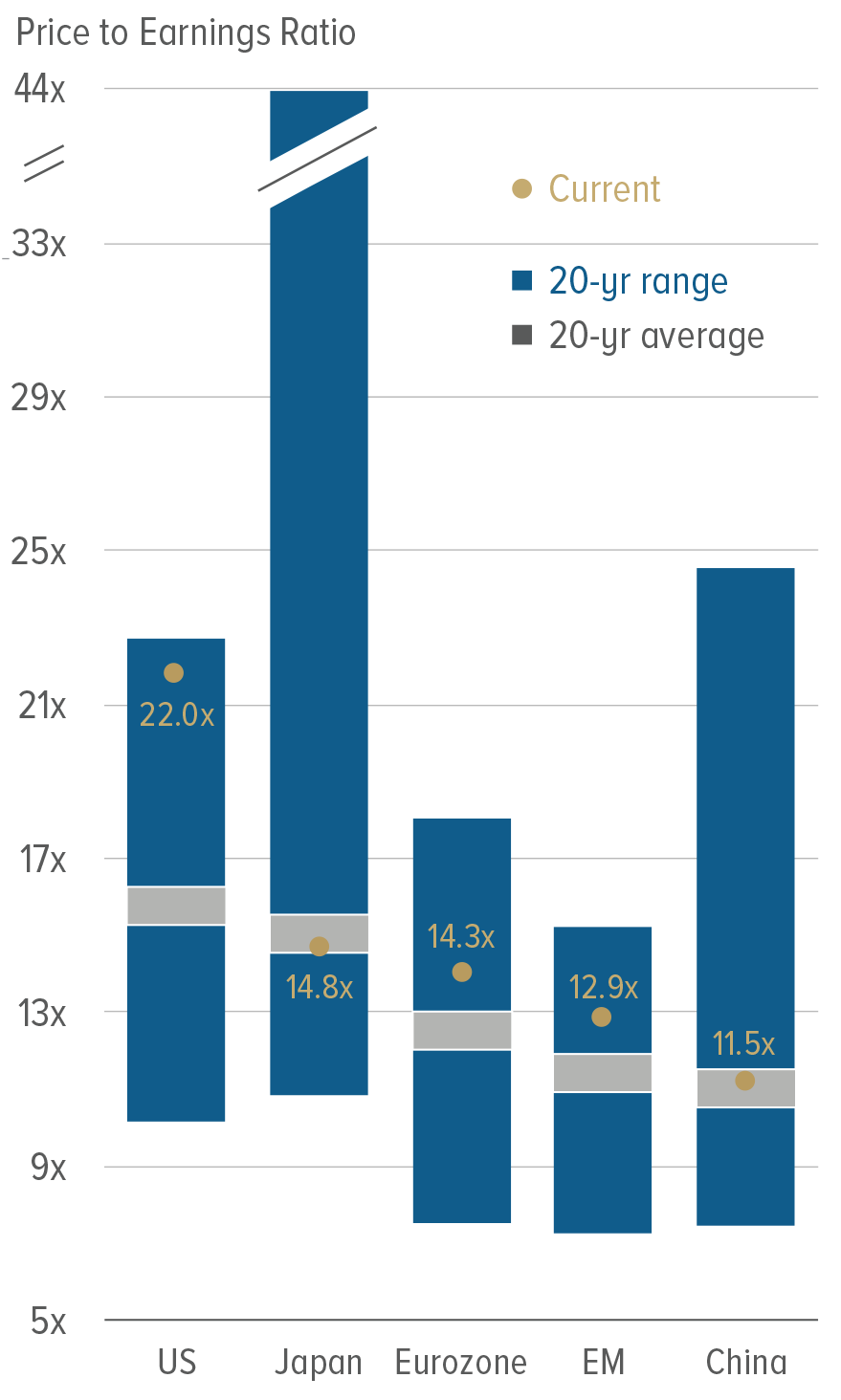
As shown in Figure 1, valuations tell a similar story. US Stocks are currently valued far above their 20-year average, especially when compared to the rest of the world. These valuation differentials have historically followed with periods of strong catch-up performance. Over time, markets reprice the less expensive regions, delivering outsized returns to savvy investors who stay the course.
Even within this narrative, US markets aren’t irrelevant – far from it. The S&P 500 climbed more than 10% in Q2, hitting fresh highs. American corporations and tech behemoths maintain global profitability and innovation leadership. But the recent outperformance abroad may reflect a broader shift: flow, valuation, and policy dynamics finally converging in favor of global markets.
Beyond valuations and recent performance there are significant geopolitical factors to consider: looming tariff deadlines, renewed Middle East tensions, and talk of reshuffling Fed leadership have added uncertainty. These are global-level tremors, and in such times international markets – less tethered to US policy – have gained ground, reaffirming the timeless value of broad diversification.
For us, the takeaway is both simple and strategic. US markets remain important, but anchoring your entire equity exposure domestically may miss this broader opportunity set. By holding a significant portion of equities outside the US, portfolios are positioned to benefit from current structural trends without sacrificing core US strength.
But that doesn’t mean throwing caution into the wind. Global markets can face turbulence – tariff surprises, central bank shifts, geopolitical flare-ups. Yet those risks underscore the importance of diversification. When one market falters, another can provide ballast.
The objective isn’t to chase every trend – but to build a portfolio that can stand on multiple legs. The past several years favored US markets. Today, maintaining global exposure isn’t a concession – it’s positioning for where returns and stability can align over the next chapter. A diversified equity allocation part US, part international, unhedged currency – harvests current trends while laying groundwork for future cycles.
In the end, investing isn’t about picking a winner – it’s about assembling resilience. And as 2025 reminds us, that means embracing a world that includes US exceptionalism – but isn’t confined by it.
Figure 1
GLOBAL EQUITY VALUATIONS
Valuations by Country/Region
ALL TIME HIGHS AREN’T NECCESSARILY A WARNING
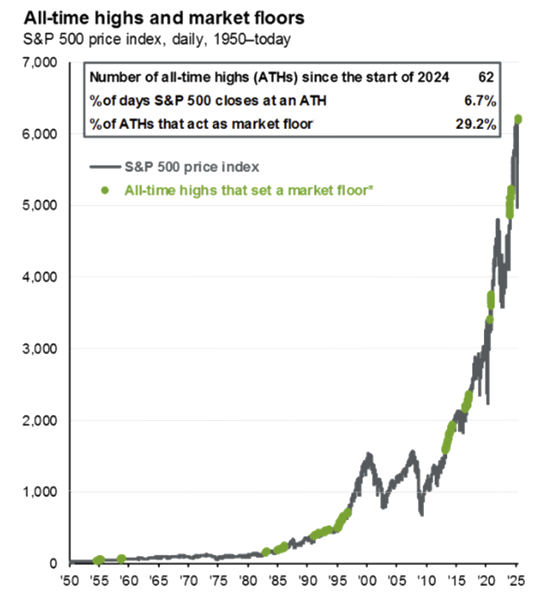
When markets reach all-time highs, many feel nervous. Yet history emphasizes why staying fully invested over the long term makes sense.
Since 1950, the S&P 500 has hit over 1,300 all-time highs, accounting for roughly 7% of trading days. An investor avoiding investing during these time periods would be leaving serious money on the table. Notably, 29% of these highs acted as new “floors,” meaning the market never fell more than 5% afterward.3 In other words, time invested in the market is far more valuable than any attempt at outsmarting it.
Staying fully invested means you benefit from compounding growth and avoid missing out on the market’s strongest days – often clustered around highs. Rather than holding back, being invested through peaks and valleys has proven to be a winning long-term approach. All-time highs are not exit signals – they’re reminders of markets’ enduring upward path.
Figure 2
ALL TIME HIGHS AND MARKET FLOORS
S&P 500 Price Index, Daily, 1950-today

Five Key Provisions
of New Tax Law Affecting Estate Planning
IMPLICATIONS OF THE CHANGES MADE BY THE ONE BIG BEAUTIFUL BILL ACT.
SOMODEVILLA/GETTY IMAGES NEWS/GETTY IMAGES
Kim Kamin, Les Carter
July 14, 2025
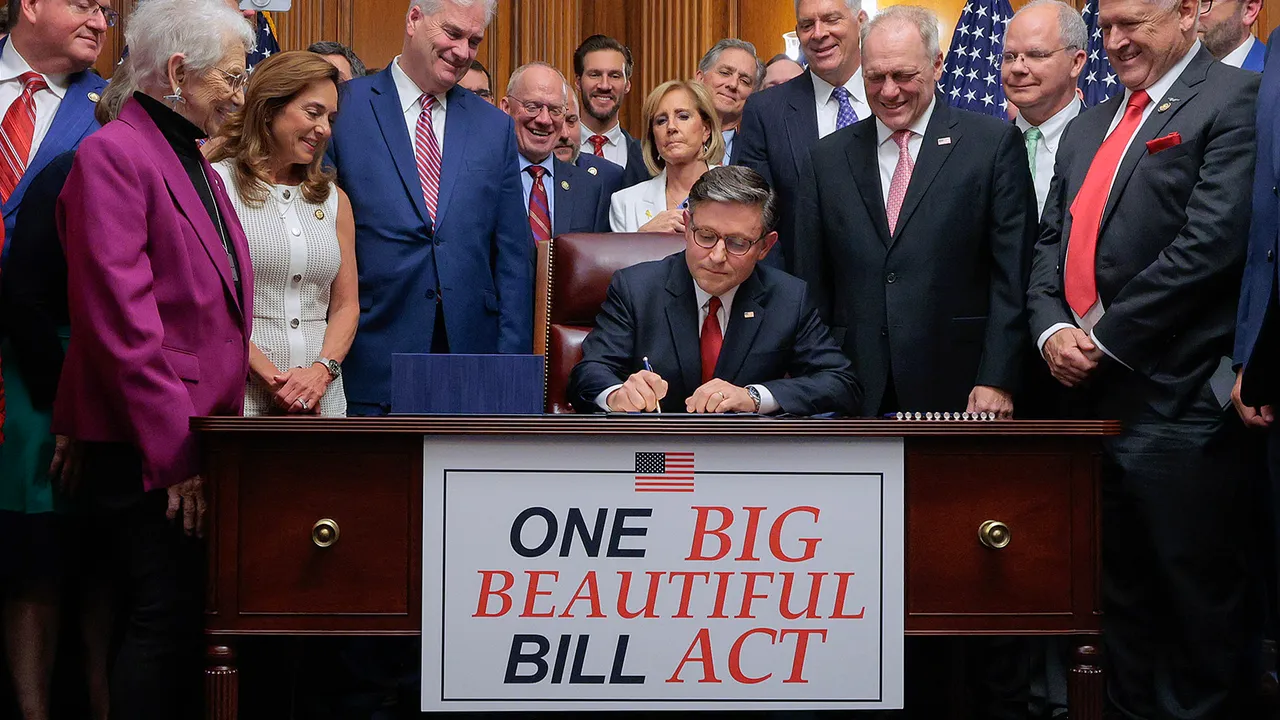
On July 4, 2025, President Donald Trump signed into law the nearly 900-page One Big Beautiful Bill, a comprehensive package of tax cuts and fiscal policy changes. The bill includes significant modifications to individual, estate and business tax provisions. Several aspects of the bill may have a meaningful impact on tax and estate planning strategies.
Transfer Tax Exemptions Increased
Provision: The estate, gift and generation-skipping transfer (GST) tax exemptions, currently $13.99 million per person, were scheduled to be cut in half next year. The bill instead increases the base exemption to $15 million per person beginning in 2026 ($30 million per couple) and continues annual adjustments for inflation.
Implications: With no scheduled sunset, the increased exemption provides additional transfer opportunities and benefits for clients. For most ultra-high-net-worth clients, lifetime gifting advice should remain the same as it was prior to the bill. While lifetime gifting strategies still offer meaningful benefits, clients with smaller estates may now also focus more on income tax planning, including strategies that preserve basis step-up at death.
SALT Deduction Increased
Provision: For tax years 2025 through 2029, the state and local tax (SALT) deduction cap is raised to $40,000 per household, with this $40,000 limit phasing out for households with more than $500,000 in adjusted gross income (AGI). Beginning in 2026, the $40,000 cap increases 1% annually. In 2030, the cap returns to its current $10,000 level enacted in the 2017 Tax Cuts and Jobs Act (the TCJA).
Implications: Taxpayers with AGI below $500,000 may benefit from accelerating SALT payments, recognizing income strategically, or bunching deductible expenses into the 2025–2029 window. For those near or above the income phase-out threshold, income-spreading strategies, such as the use of multiple non-grantor trusts, may help preserve deductibility. These structures can potentially multiply the benefit of the increased deduction before the cap reverts to $10,000 in 2030.
Income Tax Rates Established under the TCJA Preserved
Provision: The bill locks in the lower income tax brackets enacted by the TCJA, which were originally set to expire after 2025. More specifically, the top marginal rate remains at 37% (rather than reverting to 39.6%). The broader bracket ranges, standard deduction expansion and compressed rate structure remain in place with no scheduled sunset.
Implications: With the lower TCJA rates now continued, taxpayers can build long-term income recognition, charitable giving and trust distribution strategies with more confidence about marginal rate exposure. Families considering a Roth conversion may benefit from the certainty of the lower brackets, enabling them to convert at a reduced tax cost or bunch income into low-rate years without concern about a post-2025 rate increase.
QSBS Election Benefits Expanded
Provision: The bill enhances the benefits of Internal Revenue Code Section 1202’s qualified small business stock (QSBS) election by shortening the required holding period for partial gain exclusions and increasing eligibility thresholds. Taxpayers can now exclude 50% of gain after three years, 75% after four years and 100% after five years, while the lifetime gain exclusion cap increases to $15 million per issuer (up from $10 million), and the corporate asset threshold rises to $75 million, both indexed for inflation starting in 2027.
Implications: These changes enhance the attractiveness of QSBS treatment for early-stage C corporation (C corp) investments, offering shorter holding periods for partial exclusions and a higher lifetime cap. Investors should review current and prospective QSBS holdings, assess eligibility based on the new asset threshold and consider how entity structure may impact qualification. The expanded benefits may also tilt the balance toward C corp status in certain situations where pass-through treatment was previously preferred.
QBI Deduction Preserved
Provision: The bill continues the 20% qualified business income (QBI) deduction, repealing the sunset provision that would have eliminated the deduction after 2025. This deduction allows owners of certain pass-through businesses, such as sole proprietorships, partnerships, S corporations and some trusts, to deduct up to 20% of their qualified business income, effectively reducing their taxable income and the marginal rate applied to it.
Implications: With the deduction scheduled to continue, individuals with significant pass-through income can plan with greater certainty. Strategic income timing, aggregation elections and use of non-grantor trusts may continue to help preserve QBI eligibility. For clients engaged in specified service trades or businesses, proactive planning remains essential due to ongoing phase-out limitations based on income.
Additional Items of Note
- Trump accounts. Annual contributions up to $5,000 are permitted to a so-called “Trump Account” set up for an individual under 18 years old. These accounts provide for tax-free growth and withdrawals if used for qualifying purposes (for example, first-time home purchase). Certain income limits do apply. For individuals born between 2025 and 2028, Treasury will provide a one-time $1,000 contribution to an account for that individual.
- Scholarship tax credits. Individuals who fund scholarships through approved nonprofit organizations receive a federal tax credit, effectively incentivizing private educational giving.
- Charitable giving limits. Before a taxpayer can take a charitable deduction, a 0.5% AGI floor applies, and the cap on the deductibility of cash contributions to qualified charities was increased indefinitely to 60% of AGI.
- No tax on tips or overtime. Eligible workers can deduct up to $25,000 per year in tip income (regardless of filing status) and up to $12,500 of qualified overtime pay ($25,000 per year if filing jointly), in each case subject to certain qualifications, income phase-outs and a 2028 sunset.
- Car loan interest. Individuals may deduct up to $10,000 in auto loan interest for personal-use vehicles assembled in the United States. This deduction phases out above certain income levels and sunsets in 2028.
- 2/37 limitation on itemized deductions. All itemized deductions are reduced by 2/37 of the lesser of: (1) the total itemized deductions; or (2) the amount of taxable income in excess of the top 37% bracket threshold. This doesn’t apply to determining the deduction for qualified business income from pass-through entities.
Tax-Planning Opportunities
The bill’s elimination of sunset and targeted expansions offer meaningful tax-planning opportunities, particularly for high-net-worth individuals and families. Some provisions, like the expanded SALT deduction, are time-sensitive.
Posted on wealthmanagement.com
Disclosures: Past performance is no guarantee of future results.
1 International stocks are represented by the MSCI World Ex USA Index.
2 Rennison, Joe. “The Dollar Has Its Worst Start to a Year Since 1973.” The New York Times, 30 June 2025.
3 Source: FactSet, Standard & Poors, JP Morgan Guide to the Markets 7/10/2025. Figure 1 & Figure 2: Source: JP Morgan Guide to the Markets 7/10/2025.