
Category: 2025

  • 4th Quarter 2025

    OUR QUARTERLY NEWSLETTER TO CLIENTS AND FRIENDS OF THE FIRM

    FOURTH QUARTER 2025


    2025 Year in Review

    It’s that time of year when we reflect on the dynamics that shaped last year’s investment performance and evaluate the implications for our portfolio as we move forward. Last year was marked by double-digit returns across numerous asset classes in an inflationary environment that is getting back to “normal.” We recommend logging into your client portal to see how your portfolio has performed.

    KEY TAKEAWAYS

    Emerging Markets led the charge with a staggering 34% return. Before last year, these countries struggled to recover from COVID, but they came roaring back. This remarkable rebound was fueled by rising commodity prices and increasing consumer demand, but also by a flagging dollar. When the U.S. dollar weakens, international stock funds often benefit because foreign earnings translate into more dollars, boosting returns for U.S.-based investors.

    Following closely behind, the international index’s 31.5% return reflects the broader recoveries occurring within global markets, driven largely by economic policy, improved economic sentiment, heightened consumer confidence, and again the weakening dollar.

    In the U.S., the Russell 3000 index posted a welcome 17% return, showcasing the enduring strength of the American economy. However, caution is warranted. Public investments, particularly in the U.S., have recently exhibited a tendency to inflate significantly, occasionally detaching from the reality of their earnings. This discrepancy presents a challenge for discerning investors, reinforcing the need for thorough analysis and strategic selections within our US equity allocations.

    In an environment characterized by volatility, alternatives proved their worth with an impressive 8.6% return. Their inherent ability to provide diversification and risk mitigation remained essential, particularly against the backdrop of fluctuating markets.

    Furthermore, the solid performance of global real estate, achieving an 8.6% return, demonstrates the resiliency of this asset class. An exciting development within this market segment is the emergence of data centers springing up around the country, driven by the increasing demand for data and computing power from AI. We continue to advocate for strategic allocations to real estate, underlining its critical role in maintaining portfolio stability.

    Similar to last year, private bonds in general delivered strong returns, outperforming their public investment-grade counterparts. However, for private real estate and private equity, returns being based off of “fair value” have resulted in more muted outcomes compared to public peers. As we have observed in previous years, private investments are often assessed based on real cash flows and third-party valuations, sometimes resulting in steadier, less extreme returns.

    The good news for bonds continues, as they recover from the not so “transitory” inflation shock of 2022. The U.S. Aggregate Bond Index delivered a return of 7.2%, indicating that fixed-income investments remain an important aspect of overall portfolio balance, providing a necessary ballast that we will undoubtedly need again in the future. All the asset class returns, particularly bonds, should be viewed in the context of 2.7% inflation. This return above inflation is know as the “real return,” which drives wealth creation and growth within the portfolio. For our low-risk investments to deliver at this level above inflation is a welcome reprieve from the decade of low interest rates prior to 2022.

    Following 2024’s strong performance, it’s essential to remember that the U.S. has experienced elevated returns similar to what we observed this past year throughout the last century. These periods known as the Roaring ’20s, the Nifty Fifty, and the Internet Bubble serve as notable markers in investment history. It remains to be seen whether the current AI investment trend will earn its own claim to fame or infamy in the coming years.

    As we contemplate the year ahead, we remain vigilant and prepared for potential market fluctuations. The past year has underscored the ongoing importance of a disciplined investment strategy along with diverse allocations. While much of the conversation currently centers around advancements in AI and its market implications, prudent investing remains paramount. The lessons from history ring true: after periods of well-above-average returns, there is frequently a reckoning. Piling into risk assets may be tempting, but a well-structured, diversified portfolio equipped to weather economic fluctuations is key to achieving long-term investment success.

    Thank you for your continued partnership and trust in Ariadne Wealth. Together, let’s prepare for the opportunities and challenges that 2026 will bring.

    Disclosures: Past performance is no guarantee of future results.
    Figure 1: Indices are not available for direct investment. Total returns calculated from 1/1/2025-12/31/2025, except for inflation which is calculated for the 12 months ending 11/30/2025. US Stocks = Russell 3000 Index. Int’l Stocks = MSCI EAFE Index. EM Stocks = MSCI Emerging Markets Index. Global RE = Dow Jones Global Select Real Estate Securities Index. Bonds = Bloomberg U.S. Aggregate Bond Index. Inflation = Consumer Price Index for All Urban Consumers. Alternatives = 25%/25%/50% combination of ASFYX/AQMIX/QSPIX’s calendar year total return.


    The Wall Street Journal

    Corporate profits and falling interest rates may be enough to lift the S&P 500 to a fourth-straight year of gains, the longest such streak in nearly two decades

    By Krystal Hur
    Jan. 3, 2026 at 9:00 pm ET

    Wall Street is betting that falling interest rates and strong corporate earnings will be enough to eke out yet one more year of stock-market gains. It’s going to be close.

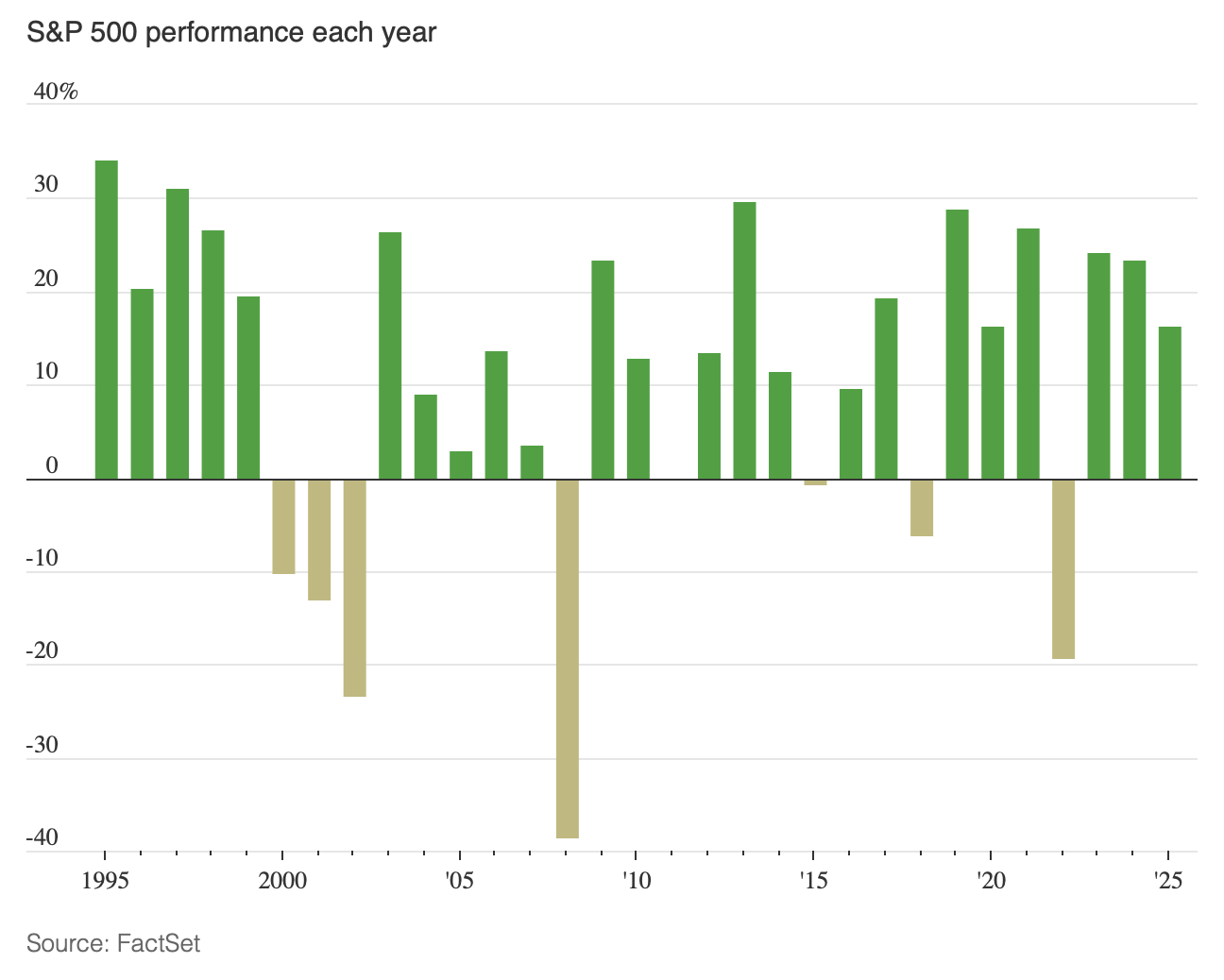
    After posting double-digit percentage increases for three straight years, from 2023 through 2025, the S&P 500 and other major U.S. indexes enter year four of their rally with stretched valuations on many big stocks and a cloudier economic picture. There are enough positives to give investors and analysts hope, but some worry there isn’t enough to keep up the pace of 2025.
    “We probably have an OK market, but certainly not what we’ve seen in the last couple years,” said Mark Hackett, chief market strategist at Nationwide.

    The S&P 500 surged 16% last year, with a resilient economy, renewed interest-rate cuts and artificial-intelligence fervor propelling the benchmark index to 39 records. The Dow Jones Industrial Average gained 13% while the Nasdaq composite jumped 20%.

    Wall Street analysts and strategists have predicted the party will continue in 2026. Bank of America expects the S&P 500 to reach 7,100 by the end of this year, a 3.7% gain from the 2025 closing level. JPMorgan Chase and Goldman Sachs expect the benchmark index to reach 7,500 and 7,600, respectively.

    Their bullishness, in light of the past gains, is reason enough to be cautious, some investors said. The S&P 500 surged roughly 80% from the start of 2023 through New Year’s Eve, a torrid pace that will be hard to maintain under most circumstances, they said.

    “It behooves investors to at least offer a little skepticism when there is such a broad consensus that everything will go well,” said Steve Sosnick, chief strategist at Interactive Brokers.

    The current rally is getting old, at least compared with past market cycles. Should the S&P 500 rise in 2026 for a fourth-consecutive year, it would be the longest such streak since 2007, when the benchmark completed a five-year run. In the index’s history, there have only been five streaks of four or more consecutive years of gains, according to Dow Jones Market Data.
    In the coming days, investors will get their next look at the economy’s health from the December jobs report. Companies will also begin reporting earnings soon, with results from big banks including JPMorgan Chase, Wells Fargo and Citigroup due in the next few weeks.

    The 2025 rally swept across more than just stocks. Gold and silver had their best year since 1979, while bonds saw their best showing since 2020. A fresh wave of speculation among individual investors spawned a new class of meme stocks and helped drive options trading volumes to records again.

    One expected boon for the market this year is lower interest rates. The Federal Reserve penciled in one quarter-point cut for this year, and some expect that President Trump’s pick for the next Fed chair after Jerome Powell’s term expires in May will lean more dovish. Tax cuts are also poised to boost corporate coffers.

    Yet, there are also signs that prices have run up too far, too fast. The price of bitcoin finished last year below $88,000 after sliding more than 30% from its record above$126,000 set in early October. Many of the meme stocks that saw huge swings higher have come down just as quickly. 

    Some analysts are also concerned that the huge gains in artificial-intelligence stocks, which have fueled much of the market’s gains over the past three years, have limited room to run further. While many believe that AI will be a transformative technology for the economy, they fret that the promised returns on multibillion-dollar investments between the major AI players will be difficult to realize, potentially weighing on future gains.

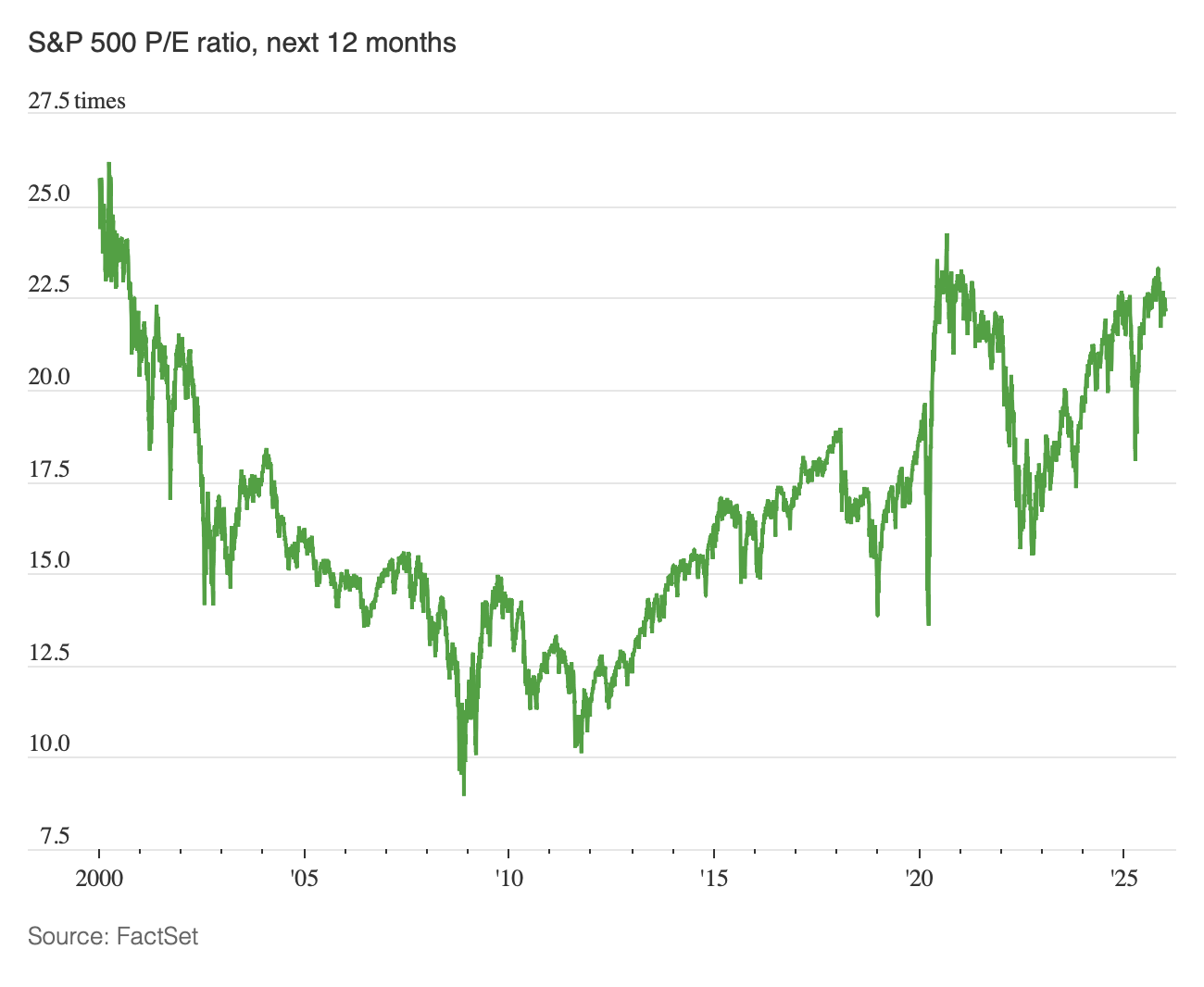
    Stock valuations are looking rich, too. Companies in the S&P 500 are trading at 22 times their expected earnings over the next 12 months, above their 10-year average of 19 times. Around half of the valuation metrics for the S&P 500 tracked by Bank of America are higher than levels seen in March 2000, near when the dot-com bubble burst.

    Many expect that the economy will continue to hold up and provide fresh fuel for the stock rally. The U.S. economy remained resilient last year despite Trump’s tariffs, persistent inflation and immigration shocks, with Americans continuing to spend and businesses continuing to invest mammoth amounts in data centers and other critical parts of AI infrastructure.

    Corporate earnings growth is expected to remain robust. Analysts polled by FactSet expect companies in the S&P 500 to report a 15% jump in profits this year, which would mark the highest annual rate of growth since 2021.

    “The base case is one in which there is sufficient momentum in the economy,” said Mark Luschini, chief investment strategist at Janney Capital Management.
  • 3rd Quarter 2025

    OUR QUARTERLY NEWSLETTER TO CLIENTS AND FRIENDS OF THE FIRM

    THIRD QUARTER 2025


    Bonds Are Back

    For more than a decade, fixed income investors faced a sobering reality: yields on high-quality bonds were persistently low. In the wake of the 2008 financial crisis, central banks across the globe, including our own Federal Reserve, slashed interest rates to near-zero levels in an effort to stimulate economic growth. The result was an era of ultra-low interest rates that left bond investors with few attractive options.

    Diversified portfolios, especially those built on the very basic 60/40 stock-bond model, faced muted returns from the bond side. For many, bonds became less about income and more about ballast—something to hold during equity drawdowns but not to drive returns.

    But that narrative is changing—and fast.

    The dramatic rise in interest rates over the last two years has been one of the most important (and underappreciated) developments in capital markets. Triggered by a post-COVID surge in inflation, the Federal Reserve embarked on its most aggressive tightening cycle in 40 years. From March 2022 through late 2023, the Fed Funds rate jumped from 0.25% to over 5%, sending shockwaves across investments of all types.

    This reset was painful in the short term, 2022 was the worst year for bonds in modern history, but it has laid the groundwork for a vastly improved forward-looking return profile. That story has been quietly playing out in 2025.

    Figure 1

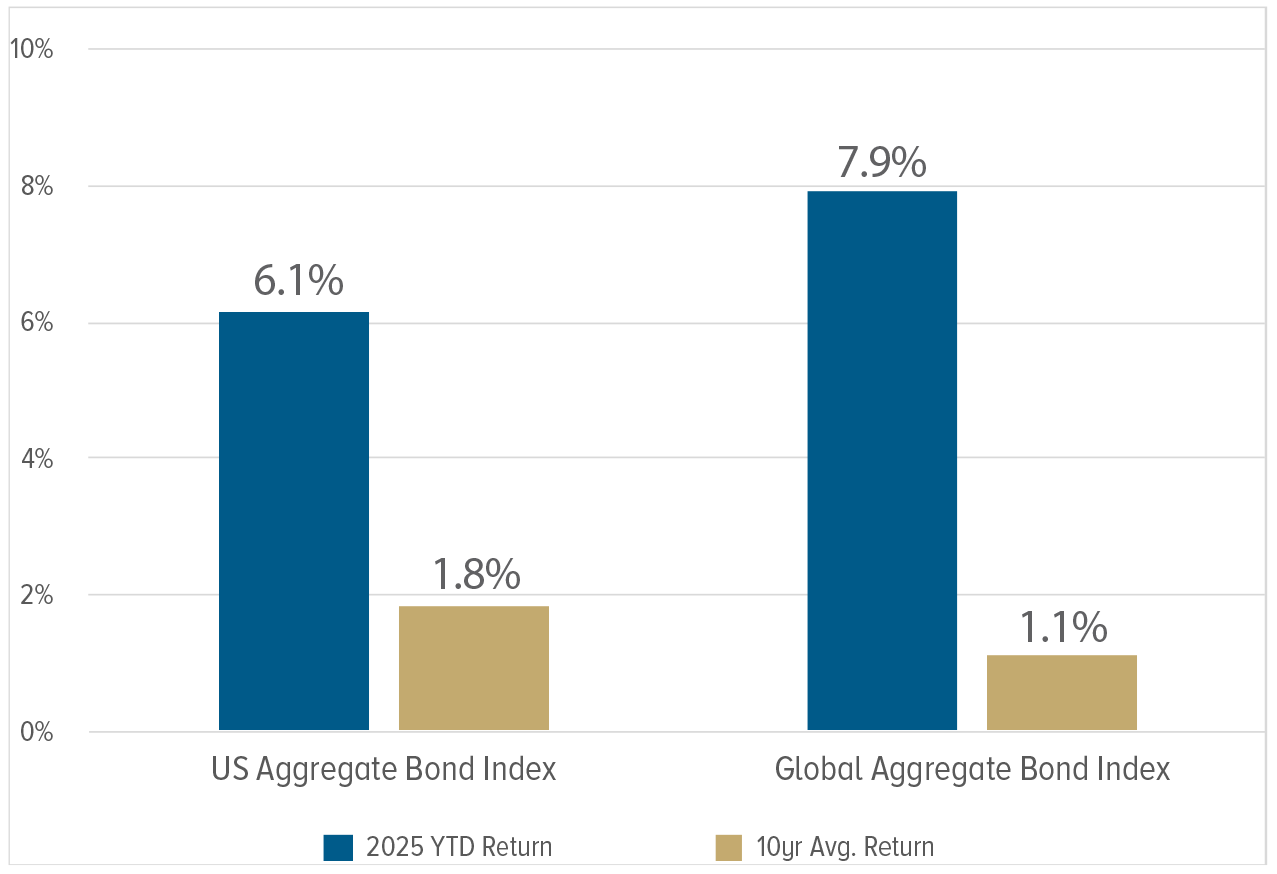
    The chart in Figure 1 tells a powerful story. Through the first three quarters of 2025, the U.S. Aggregate Bond Index has climbed 6.1%, while the Global Aggregate Bond Index has delivered an impressive 7.9%. If current momentum continues, 2025 is on track to be the strongest year for bond returns in over a decade. This marks a dramatic departure from the subdued performance of the past ten years, when yields on high-quality bonds hovered at 1-2% annually.

    Despite these impressive numbers, this shift in the bond market has been largely overlooked in the financial press. That’s unfortunate—because for the thoughtful, diversified investor, this is very good news.

    Higher interest rates have restored the ability of fixed income to contribute meaningfully to overall portfolio returns without requiring excessive credit or term risk.

    Importantly, these returns are not dependent on strong equity markets or economic surprises. They are driven by yield, the most reliable and contractual component of total return.

    Some may wonder if this opportunity has passed, especially now that the Fed has begun cutting interest rates. Even as yields modestly decline, they remain well above the recent past. The income earned on today’s bond portfolios continues to compound at attractive rates, and reinvestment risk has been manageable given the flatter trajectory of future rate cuts.

    There’s a quiet but meaningful tailwind supporting globally diversified investors: the U.S. dollar is weakening. After years of strength, the dollar is now under pressure as markets begin to anticipate lower interest rates and rising fiscal challenges. For U.S.-based bond investors with international exposure, this shift matters. When the dollar weakens, foreign bonds—denominated in local currencies—gain value when converted back into dollars, boosting returns. This currency effect has been a significant contributor to global bond performance. All things considered, 2025 has marked a clear turning point—bonds are officially back.

    Gold at All-Time Highs:
    Should It Have a Place in Your Portfolio?

    With gold recently reaching new all-time highs, it’s natural for investors to wonder whether the yellow metal deserves a place in a modern, diversified portfolio. While gold can act as a temporary safe haven during periods of market uncertainty or geopolitical stress, the long-term data suggests that its role in strategic asset allocation is limited, especially for growth-oriented investors.

    Since the early 1970s, when gold was decoupled from the U.S. dollar, its returns have lagged well behind the U.S. stock market. Stocks represent productive assets: businesses that generate earnings, pay dividends, and grow with the economy. Gold, by contrast, is inert. It doesn’t generate cash flows, and its value is largely sentiment-driven.

    Although we don’t invest in gold itself, our managed futures strategies do capitalize on price trends in gold as well as dozens of other assets. This approach to commodity investing allows investors to benefit from gold’s momentum while maintaining a more flexible and risk-managed portfolio.

    In short, while the headlines may tempt you, gold’s recent rally is not a reason to deviate from a disciplined, evidence-based investment strategy. We continue to believe that a globally diversified portfolio offers the best path to long-term financial success.

    Disclosures: Past performance is no guarantee of future results. For illustrative purposes only.


    The Wall Street Journal
    The U.S. currency’s rise and fall from prominence in the early 20th century offers
    lessons for today’s political leaders.

    By Barry Eichengreen
    Sept. 11, 2025 at 10:00 am ET

    Is the U.S. dollar’s position as the world’s reserve currency on shaky ground?

    Some people think so, pointing to President Trump’s tariffs, America’s growing debt and its use of financial sanctions as a foreign-policy tool. Russia, barred from using the dollar in 2022, has shifted to using the Chinese renminbi for its international transactions. Other countries are exploring alternatives, as well, amid concerns that America’s outsize engagement in the global economy could end and debt will force the Federal Reserve to keep policy rates low, fueling inflation and dollar depreciation.

    To many others, however, such claims seem far-fetched. The very fact that the U.S. currency is so widely used, and that the U.S. economy is so large, means its international role is secure.

    But those espousing this Panglossian perspective forget that the dollar lost its primacy once before. It is a story worth retelling.

    The dollar’s rise

    The dollar wasn’t used internationally at all before World War I, when Britain’s pound sterling was the world’s currency. U.S. banks weren’t permitted to branch abroad and America had no central bank to backstop its financial markets.

    That changed following passage of the Federal Reserve Act in 1913, which created that central bank and permitted American commercial banks to branch overseas.

    The Fed’s founders, who needed to overcome Americans’ deep-seated aversion to concentrated financial power, had various motivations for wanting to create a new U.S. banking system. Carter Glass of Virginia, the crusty, self-styled financial expert in the U.S. House and co-sponsor of the Glass-Owen Federal Reserve bill, sought a decentralized system of public banks to provide credit to financially underserved Southerners. Nelson Aldrichof Rhode Island, influential chairman of the Senate Finance Committee, wanted a European style central bank, along the lines of
    the Bank of England or the German Reichsbank, to mitigate financial crises.

    For Paul Warburg, the cerebral, mustachioed German-American banker and one of the country’s most influential financial commentators, America’s dependence on sterling was a competitive disadvantage because it forced U.S. exporters to source trade credit abroad and shoulder exchange rate risk. Warburg lobbied for a central bank to make a market in dollar trade credits, essentially short-term IOUs that function as a promise of future payment. Warburg’s bank would stand ready to buy those credits, known as trade acceptances, at a preset price, making their cost and availability steady and predictable and allowing U.S. importers and exporters to use the dollar to finance their trade.

    Warburg’s vision became reality when he accompanied Aldrich to a secret meeting in 1910 on Jekyll Island, off the coast of Georgia, where a group of prominent bankers hammered out the essentials of the Federal Reserve Act. President Woodrow Wilson appointed Warburg to the Federal Reserve Board, a perch from which he encouraged the Fed to support the nascent dollar credit market. Warburg advocated relaxing restrictions on the types of credits the Fed could purchase or discount, giving the central bank a role in financing not just merchandise trade, but purely financial transactions such as short-term loans and then dollar acceptances originated by foreign banks, as well. To further promote the market, Warburg in 1919 founded the American Acceptance Council to be a policy advocate for the industry.

    In 1921, he formed the International Acceptance Bank, under whose umbrella a consortium of banks provided dollar finance for foreign trade.

    By the late 1920s, largely through the efforts of this one man, New York had become the leading source of trade credit, and the dollar had supplanted sterling as the leading international currency. To be sure, Warburg’s efforts were supported by favorable structural conditions. The U.S. was the single largest economy from 1880. It became the leading national exporter in 1913. After World War I it had the largest financial markets, and it was the leading source of foreign loans. Thus, there was nothing paradoxical about the dollar’s rise—other than how long it had taken to get there.

    The dollar’s fall

    But what was gained could equally be lost. Starting in 1929, with the onset of the Great Depression, U.S. imports and exports fell. The Smoot-Hawley Tariff and the foreign retaliation that followed dealt trade another blow.

    Three devastating financial crises disrupted the flow of finance and discouraged importers and exporters from relying on the U.S. banking system.

    At this time, a third of all outstanding dollar acceptance paper held by U.S. banks and the Federal Reserve had originated abroad, mostly in Germany. In the aftermath of hyper inflation in 1922-23, the German public remained understandably reluctant to entrust its savings to domestic banks. Those cash-strapped banks lent to German importers and exporters only at double-digit interest rates. American banks, flush with funds and finding those rates irresistible, provided trade credit to German banks, which passed it on to German firms. The dollar acceptance market was now underwriting the transactions of foreign, as well as American, merchants and producers, signifying the U.S. dollar’s greatly expanded international role.

    It all came tumbling down when distressed U.S. banks stopped lending. The German government responded with a moratorium on the country’s debts, including its acceptance credits. U.S. banks, including the Federal Reserve Banks, were left holding the bag. That is to say, they were left holding potentially worthless foreign acceptance paper.

    The Fed refused to step in and sustain the market, compounding the problem. The sharp decline in the share of dollar acceptances purchased by the Reserve Banks spawned an equally sharp decline in the value of acceptances issued in the U.S. By 1934 the value of dollar acceptances had fallen to barely half their sterling equivalent.

    Why was the dollar’s international position allowed to erode so dramatically?

    First, personnel mattered. Benjamin Strong, the influential governor of the Federal Reserve Bank of New York,was a confidant of Warburg, arguably his dearest friend. A die-hard internationalist, Strong appreciated the role of the Fed in supporting the global dollar. Strong died from tuberculosis in His successor, George Harrison, was less attuned to the need to support the market in dollar trade credits.

    Second, politics mattered. Glass had ascended to the Senate, where he chaired the influential Subcommittee on Banking and Currency. Glass blamed the Wall Street boom and bust on lax Fed regulations, adopted at Warburg’s insistence, and on Strong’s hyperactive support of the dollar acceptance market. Their actions, in his view, had fueled reckless speculation leading to the financial collapse, a view echoed by President Herbert Hoover. Glass now pressured the Fed to limit its purchases to acceptances financing merchandise trade. These “real bills” were safely collateralized by underlying merchandise, so they were guaranteed to perform. And because they financed legitimate economic activity, discounting them wouldn’t fan financial speculation.

    Sensitive to the criticism, the Reserve Banks curtailed their operations. Commercial banks, uncertain now about whether the central bank would guarantee the liquidity of the market, grew more reluctant to purchase acceptances. Eventually, America recovered from the Great Depression. Its once vital international acceptance market didn’t.

    It wasn’t until after World War II that the dollar became the leading global currency once again, in effect by default since the U.S. economy was the only one left standing. The Fed, having been chastened by the earlier experience, now acknowledged its responsibility to act as lender and liquidity provider of last resort, and thereby to promote and sustain the dollar’s dominant international role. That led to a remarkable streak of financial stability in the quarter-century following the war.

    The lessons for 2025 are clear. The dollar’s international primacy isn’t eternal. To be sustained, it has to be actively fostered and preserved. It must be supported by competent officials. An astute, experienced Federal Reserve head is key. Politicians interfere at their peril.

  • 2nd Quarter 2025

    OUR QUARTERLY NEWSLETTER TO CLIENTS AND FRIENDS OF THE FIRM

    SECOND QUARTER 2025


    Short-Term International Success, Long-Term Global Balance

    It’s mid 2025, and the world’s markets have flipped a long-standing script. For years, US equities led the global charge – especially the tech giants. But this year, that dominance has paused. Through the first half of the year, international stocks have surged roughly 18.5%, while the S&P 500 sits at a 6% gain.1 That divergence recalls past moments when leadership shifted from the US to Europe, Japan, or emerging markets – and signals we might be living through another such inflection.

    The most obvious catalyst has been the US dollar. The first half of 2025 saw the steepest drop in the dollar since 1973, which inversely means foreign currencies have strengthened considerably.2 These stronger foreign currencies enhance international stock returns, explaining much of the difference across the globe so far this year.

    There are deeper reasons behind this shift. In contrast with our Federal Reserve’s current positioning where rates have been held steady, central banks beyond the US have begun signaling rate cuts. Combined with fiscal stimulus – like Germany’s €500 billion infrastructure package and ramped-up defense spending – this has led to stronger earnings growth abroad.

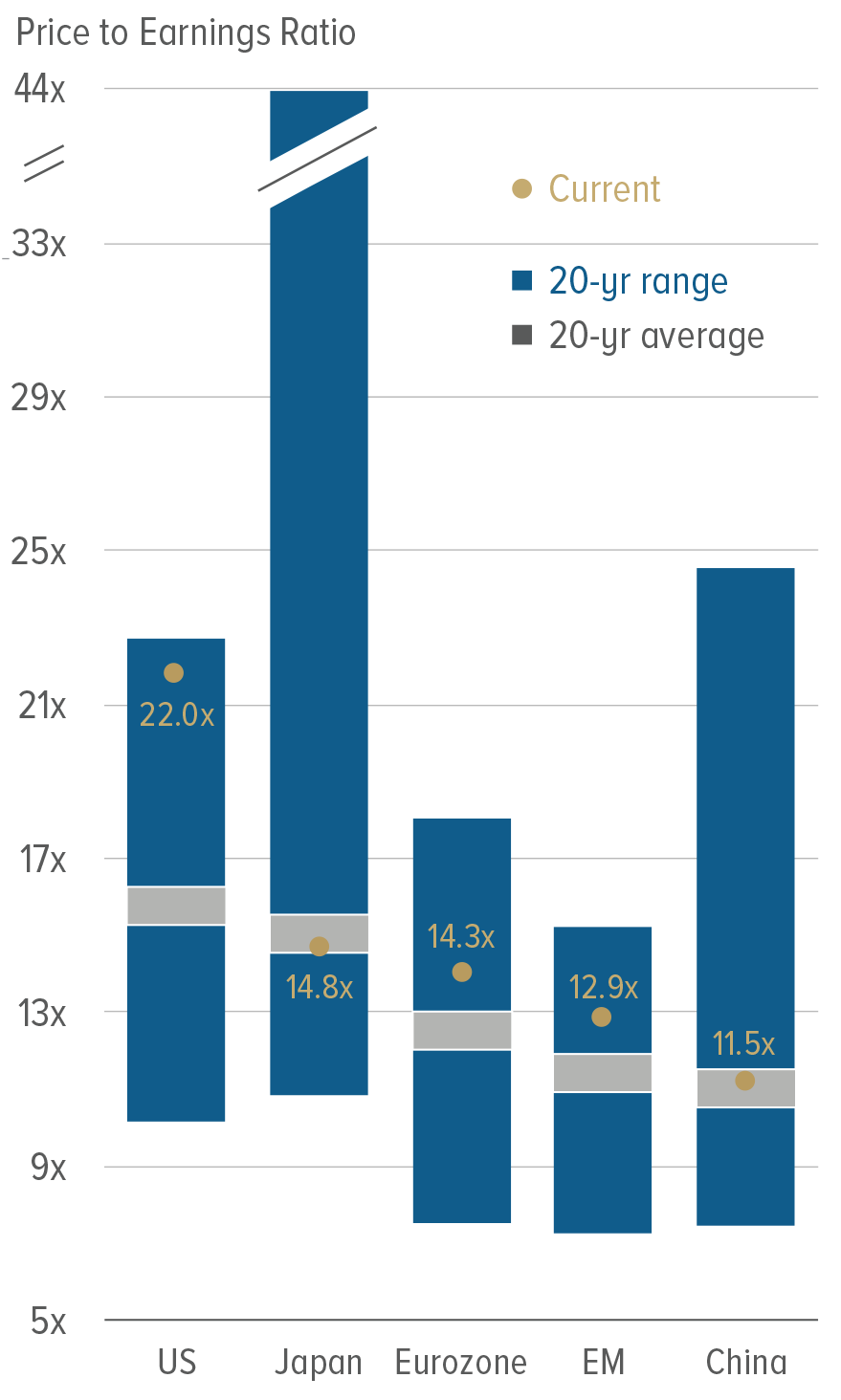
    As shown in Figure 1, valuations tell a similar story. US Stocks are currently valued far above their 20-year average, especially when compared to the rest of the world. These valuation differentials have historically followed with periods of strong catch-up performance. Over time, markets reprice the less expensive regions, delivering outsized returns to savvy investors who stay the course.

    Even within this narrative, US markets aren’t irrelevant – far from it. The S&P 500 climbed more than 10% in Q2, hitting fresh highs. American corporations and tech behemoths maintain global profitability and innovation leadership. But the recent outperformance abroad may reflect a broader shift: flow, valuation, and policy dynamics finally converging in favor of global markets.

    Beyond valuations and recent performance there are significant geopolitical factors to consider: looming tariff deadlines, renewed Middle East tensions, and talk of reshuffling Fed leadership have added uncertainty. These are global-level tremors, and in such times international markets – less tethered to US policy – have gained ground, reaffirming the timeless value of broad diversification.

    For us, the takeaway is both simple and strategic. US markets remain important, but anchoring your entire equity exposure domestically may miss this broader opportunity set. By holding a significant portion of equities outside the US, portfolios are positioned to benefit from current structural trends without sacrificing core US strength.

    But that doesn’t mean throwing caution into the wind. Global markets can face turbulence – tariff surprises, central bank shifts, geopolitical flare-ups. Yet those risks underscore the importance of diversification. When one market falters, another can provide ballast.

    The objective isn’t to chase every trend – but to build a portfolio that can stand on multiple legs. The past several years favored US markets. Today, maintaining global exposure isn’t a concession – it’s positioning for where returns and stability can align over the next chapter. A diversified equity allocation part US, part international, unhedged currency – harvests current trends while laying groundwork for future cycles.

    In the end, investing isn’t about picking a winner – it’s about assembling resilience. And as 2025 reminds us, that means embracing a world that includes US exceptionalism – but isn’t confined by it.

    ALL TIME HIGHS AREN’T NECCESSARILY A WARNING

    When markets reach all-time highs, many feel nervous. Yet history emphasizes why staying fully invested over the long term makes sense.

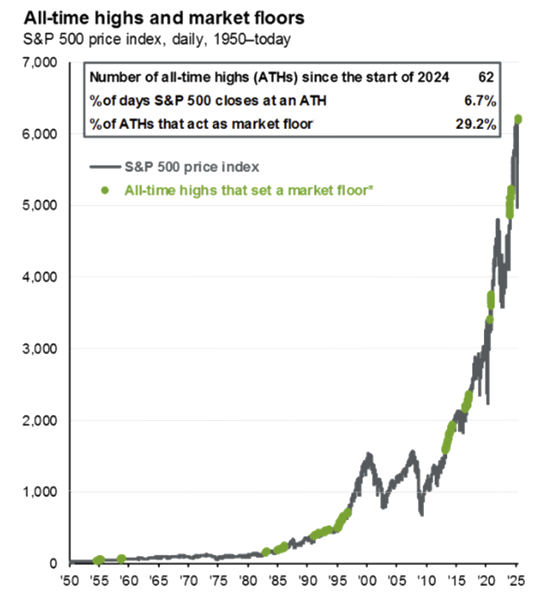
    Since 1950, the S&P 500 has hit over 1,300 all-time highs, accounting for roughly 7% of trading days. An investor avoiding investing during these time periods would be leaving serious money on the table. Notably, 29% of these highs acted as new “floors,” meaning the market never fell more than 5% afterward.3 In other words, time invested in the market is far more valuable than any attempt at outsmarting it.

    Staying fully invested means you benefit from compounding growth and avoid missing out on the market’s strongest days – often clustered around highs. Rather than holding back, being invested through peaks and valleys has proven to be a winning long-term approach. All-time highs are not exit signals – they’re reminders of markets’ enduring upward path.

    Figure 2

    ALL TIME HIGHS AND MARKET FLOORS
    S&P 500 Price Index, Daily, 1950-today

    IMPLICATIONS OF THE CHANGES MADE BY THE ONE BIG BEAUTIFUL BILL ACT.
    Speaker of the House Mike Johnson signs the One Big Beautiful Bill Act before sending it on to President Donald TrumpCHIP
    SOMODEVILLA/GETTY IMAGES NEWS/GETTY IMAGES

    Kim Kamin, Les Carter
    July 14, 2025

    On July 4, 2025, President Donald Trump signed into law the nearly 900-page One Big Beautiful Bill, a comprehensive package of tax cuts and fiscal policy changes. The bill includes significant modifications to individual, estate and business tax provisions. Several aspects of the bill may have a meaningful impact on tax and estate planning strategies.

    Transfer Tax Exemptions Increased

    Provision: The estate, gift and generation-skipping transfer (GST) tax exemptions, currently $13.99 million per person, were scheduled to be cut in half next year. The bill instead increases the base exemption to $15 million per person beginning in 2026 ($30 million per couple) and continues annual adjustments for inflation.

    Implications: With no scheduled sunset, the increased exemption provides additional transfer opportunities and benefits for clients. For most ultra-high-net-worth clients, lifetime gifting advice should remain the same as it was prior to the bill. While lifetime gifting strategies still offer meaningful benefits, clients with smaller estates may now also focus more on income tax planning, including strategies that preserve basis step-up at death.

    SALT Deduction Increased 

    Provision: For tax years 2025 through 2029, the state and local tax (SALT) deduction cap is raised to $40,000 per household, with this $40,000 limit phasing out for households with more than $500,000 in adjusted gross income (AGI). Beginning in 2026, the $40,000 cap increases 1% annually. In 2030, the cap returns to its current $10,000 level enacted in the 2017 Tax Cuts and Jobs Act (the TCJA).

    Implications: Taxpayers with AGI below $500,000 may benefit from accelerating SALT payments, recognizing income strategically, or bunching deductible expenses into the 2025–2029 window. For those near or above the income phase-out threshold, income-spreading strategies,  such as the use of multiple non-grantor trusts, may help preserve deductibility. These structures can potentially multiply the benefit of the increased deduction before the cap reverts to $10,000 in 2030.

    Income Tax Rates Established under the TCJA Preserved

    Provision: The bill locks in the lower income tax brackets enacted by the TCJA, which were originally set to expire after 2025. More specifically, the top marginal rate remains at 37% (rather than reverting to 39.6%). The broader bracket ranges, standard deduction expansion and compressed rate structure remain in place with no scheduled sunset.

    Implications: With the lower TCJA rates now continued, taxpayers can build long-term income recognition, charitable giving and trust distribution strategies with more confidence about marginal rate exposure. Families considering a Roth conversion may benefit from the certainty of the lower brackets, enabling them to convert at a reduced tax cost or bunch income into low-rate years without concern about a post-2025 rate increase.

    QSBS Election Benefits Expanded

    Provision: The bill enhances the benefits of Internal Revenue Code Section 1202’s qualified small business stock (QSBS) election by shortening the required holding period for partial gain exclusions and increasing eligibility thresholds. Taxpayers can now exclude 50% of gain after three years, 75% after four years and 100% after five years, while the lifetime gain exclusion cap increases to $15 million per issuer (up from $10 million), and the corporate asset threshold rises to $75 million, both indexed for inflation starting in 2027.

    Implications: These changes enhance the attractiveness of QSBS treatment for early-stage C corporation (C corp) investments, offering shorter holding periods for partial exclusions and a higher lifetime cap. Investors should review current and prospective QSBS holdings, assess eligibility based on the new asset threshold and consider how entity structure may impact qualification. The expanded benefits may also tilt the balance toward C corp status in certain situations where pass-through treatment was previously preferred.

    QBI Deduction Preserved

    Provision: The bill continues the 20% qualified business income (QBI) deduction, repealing the sunset provision that would have eliminated the deduction after 2025. This deduction allows owners of certain pass-through businesses, such as sole proprietorships, partnerships, S corporations and some trusts, to deduct up to 20% of their qualified business income, effectively reducing their taxable income and the marginal rate applied to it.

    Implications: With the deduction scheduled to continue, individuals with significant pass-through income can plan with greater certainty. Strategic income timing, aggregation elections and use of non-grantor trusts may continue to help preserve QBI eligibility. For clients engaged in specified service trades or businesses, proactive planning remains essential due to ongoing phase-out limitations based on income.

    Additional Items of Note

    • Trump accounts. Annual contributions up to $5,000 are permitted to a so-called “Trump Account” set up for an individual under 18 years old. These accounts provide for tax-free growth and withdrawals if used for qualifying purposes (for example, first-time home purchase). Certain income limits do apply. For individuals born between 2025 and 2028, Treasury will provide a one-time $1,000 contribution to an account for that individual.
    • Scholarship tax credits. Individuals who fund scholarships through approved nonprofit organizations receive a federal tax credit, effectively incentivizing private educational giving.
    • Charitable giving limits. Before a taxpayer can take a charitable deduction, a 0.5% AGI floor applies, and the cap on the deductibility of cash contributions to qualified charities was increased indefinitely to 60% of AGI.
    • No tax on tips or overtime. Eligible workers can deduct up to $25,000 per year in tip income (regardless of filing status) and up to $12,500 of qualified overtime pay ($25,000 per year if filing jointly), in each case subject to certain qualifications, income phase-outs and a 2028 sunset.
    • Car loan interest. Individuals may deduct up to $10,000 in auto loan interest for personal-use vehicles assembled in the United States. This deduction phases out above certain income levels and sunsets in 2028.
    • 2/37 limitation on itemized deductions. All itemized deductions are reduced by 2/37 of the lesser of: (1) the total itemized deductions; or (2) the amount of taxable income in excess of the top 37% bracket threshold. This doesn’t apply to determining the deduction for qualified business income from pass-through entities.

    Tax-Planning Opportunities

    The bill’s elimination of sunset and targeted expansions offer meaningful tax-planning opportunities, particularly for high-net-worth individuals and families. Some provisions, like the expanded SALT deduction, are time-sensitive.


    Posted on wealthmanagement.com

    Disclosures: Past performance is no guarantee of future results.
    1 International stocks are represented by the MSCI World Ex USA Index.
    2 Rennison, Joe. “The Dollar Has Its Worst Start to a Year Since 1973.” The New York Times, 30 June 2025.
    3 Source: FactSet, Standard & Poors, JP Morgan Guide to the Markets 7/10/2025. Figure 1 & Figure 2: Source: JP Morgan Guide to the Markets 7/10/2025.

  • 1st Quarter 2025

    OUR QUARTERLY NEWSLETTER TO CLIENTS AND FRIENDS OF THE FIRM

    FIRST QUARTER 2025


    Embracing Uncertainty

    Last October we sent out a flyer titled “Uncertainty is Underrated,” written by investment legend David Booth. In it, he emphasized that uncertainty should be embraced as the very reason we earn returns on our investments. Without risk, we’d have no reward. With the global stock market in a period of upheaval, we believe it’s essential to revisit the importance of portfolio diversification that serves to balance both sides of the risk reward equation.

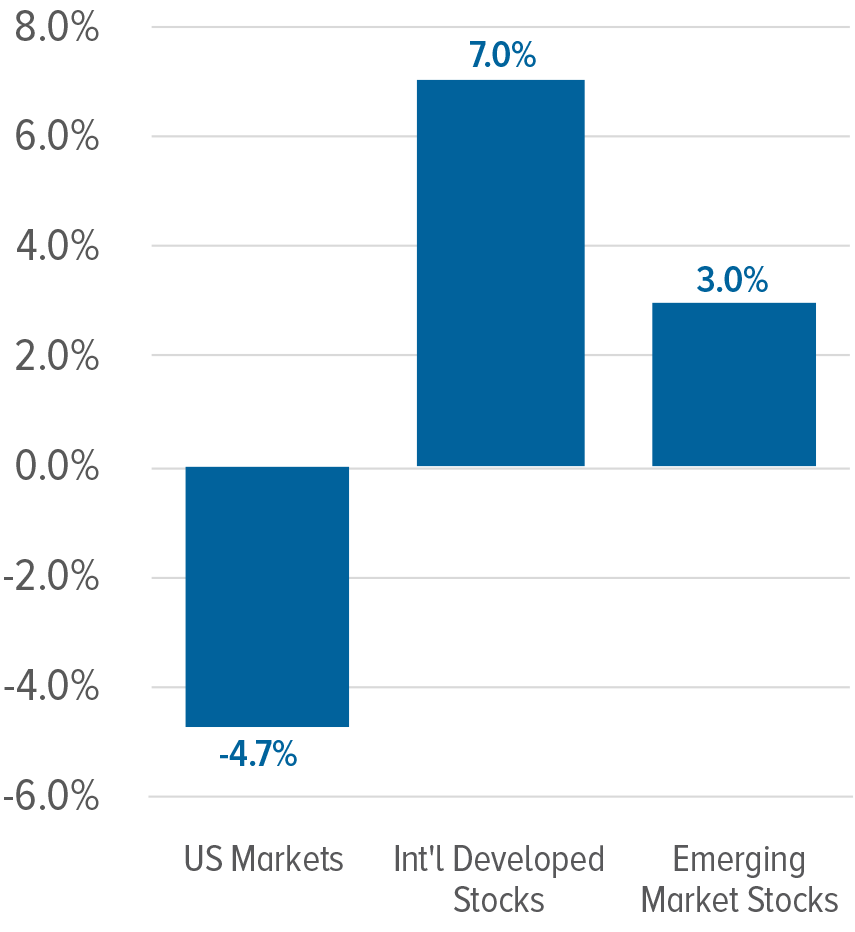
    As displayed in Figure 1, the first quarter of this year has been markedly different for US markets versus those abroad. International equities are (so far) outperforming domestic equities by a wide margin. Time will tell whether this trend continues into the future and for how long, but let’s take a look at some of the reasons for this performance disparity and how our portfolios are designed to adapt regardless of which asset class leads the charge.

    Economically, the U.S. pivot toward new tariffs and protectionist trade policy marks a notable departure from the era of global free trade. This shift introduces new pressure points for global supply chains and inflation. We’ve prepared for times like these by emphasizing both international diversification and targeting alternative investments in assets that have historically performed well during volatile periods. Both are designed to preserve purchasing power and generate returns in a changing macroeconomic climate.

    Geopolitically, the United States is stepping back from traditional roles in international military engagement and foreign aid, creating new risks and power vacuums in global affairs. Our portfolios’ broad international diversification, commitment to private assets, and exposure to fixed and floating rate bonds similarly help protect against these changes. By allocating across a wide range of global markets and regions, we aim to reduce exposure to any single country’s policy decisions and enhance resilience in the face of geopolitical volatility.

    Technologically, artificial intelligence is revolutionizing how businesses operate and compete. Rather than viewing this as a disruption, we see it as a powerful long-term opportunity. Our investment strategy includes exposure to all aspects of the AI ecosystem, from the leading technology firms driving innovation to the infrastructure, hardware, and energy sources powering this transformation. This balanced approach ensures our clients are positioned to benefit from AI’s growth while managing the risks that come with any major shift.

    Why Private Equity

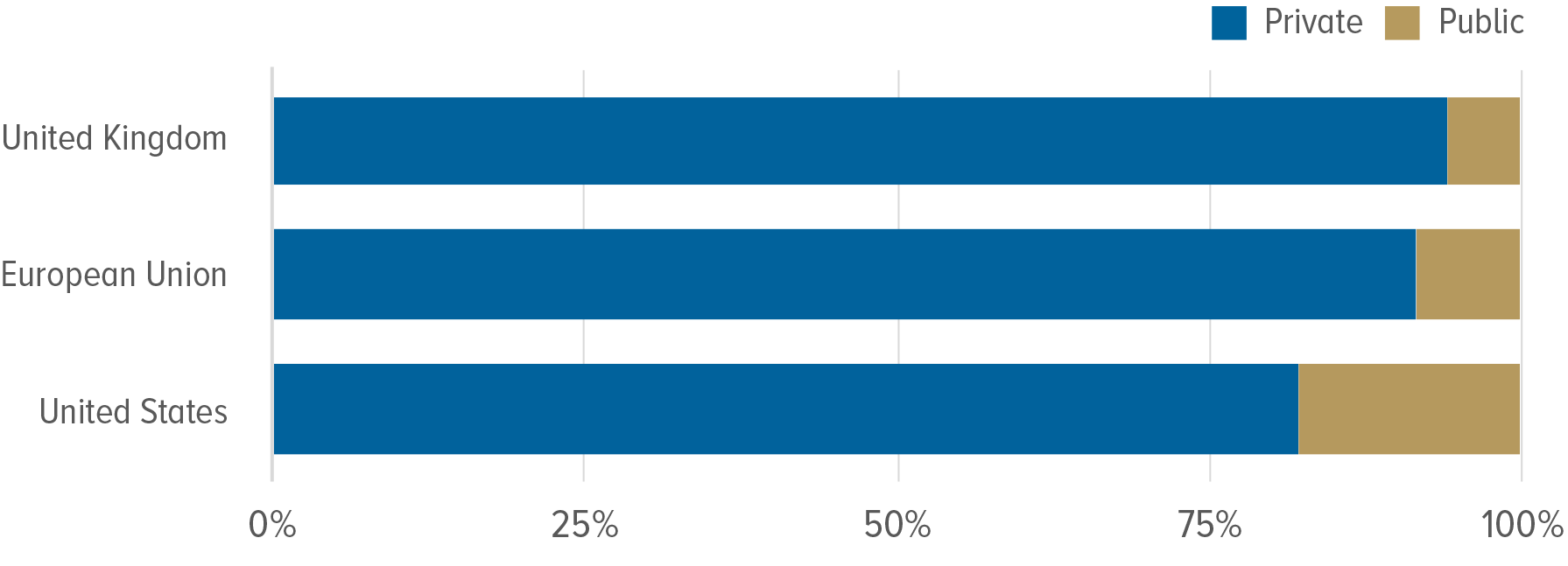
    Over the last few decades, the investment landscape has changed dramatically—and one of the most significant shifts has been the shrinking number of public companies. According to the US Census Bureau, the number of publicly listed U.S. stocks fell 24% from 1996 to 2020 while at the same time, the number of private companies surged 46%. Today, as shown in Figure 2, for every public company there are dozens of private businesses operating across industries and geographies. In short, if you want to truly “own the economy,” you need to own private equity.

    The forces keeping companies from going public vary but anecdotal evidence points to greater control for the founders, less regulatory burden, lower legal and other costs, and more of an ability to pursue long-term goals. These companies range from early-stage startups to mature firms undergoing ownership transitions. However, for most investors, gaining access to this market has historically been a challenge.

    For years, the only way to invest in private equity was through traditional drawdown funds, which are complex structures typically used by large institutions. These funds required investors to commit capital up front and wait for it to be “called” over several years as opportunities arose. Returns could take a decade or more to fully realize, and minimum investment sizes were often in the millions of dollars. For all but the ultra-wealthy or institutional investors, private equity was out of reach.

    That’s changing. A new generation of investment vehicles such as interval or evergreen funds has made private equity far more accessible. These structures allow individual investors to access professionally managed portfolios of private companies with lower minimums, simplified reporting, and greater diversification. While these vehicles are not as liquid as public investments, this lesser liquidity can actually be an advantage.

    Academic research supports the existence of an illiquidity premium, or the additional return investors can expect to earn for owning investments with limited liquidity. This premium, combined with the lower realized volatility of private investments, has been a key contributor to private equity’s historical outperformance over public market investments.1 This makes them unsuitable for money that may be needed in the short term, but entirely appropriate as part of a long-term investment strategy.

    As always, we approach private equity with the same discipline and due diligence we apply to every part of your portfolio. We believe that thoughtful allocation to private markets, balanced with the need for liquidity, risk tolerance, and long-term goals, can meaningfully enhance investment outcomes over time.

    By Hillary Chabot
    February 20, 2025

    As talk of tariffs, global trading, and domestic industry dominate the headlines, we asked Babson College Associate Professor of Economics Joshua Stillwagon to help break down the basics behind this international trade tactic—what are tariffs, why are they implemented, and who do they impact?

    “Tariffs are basically a tax on imported goods,” Stillwagon said. Tariffs can take various forms, such as a percentage of the imported goods’ value or a fixed fee per unit. While tariffs have been used for centuries, their effectiveness and economic consequences remain debated among economists and policymakers.

    “Although economists are generally negative on tariffs, targeted tariffs for certain consumer products could be rational in the short term to prevent ‘dumping’ by other countries, which may threaten the existence of our domestic industry,” Stillwagon explained. Dumping occurs when a company sells a product in another country at a lower price than in its home market.

    Governments impose tariffs for multiple reasons, said Stillwagon, who also serves as chair of Babson’s Economic Division. The primary motivations include:

    PROTECTING DOMESTIC INDUSTRIES
    One of the most cited reasons for implementing tariffs is to encourage domestic production by making imported goods more expensive. This can increase demand for locally produced alternatives, boosting profits and growth in the protected industry, at a cost to consumers.

    Stillwagon noted that their effectiveness depends on how they are structured.

    “If you want to boost production in the U.S., it’s better to have a more targeted approach,” Stillwagon cautioned. “Broad tariffs on essential materials like steel and aluminum increase costs for numerous industries, which would ultimately harm economic growth.

    GENERATING GOVERNMENT REVENUE
    Tariffs can serve as a source of income for the government, as companies importing goods must pay taxes upon entry. However, if tariffs significantly reduce imports, the revenue generated from them may diminish over time.

    TRADE NEGOTIATION LEVERAGE
    Tariffs can be used as a bargaining tool to encourage foreign governments to reduce their own tariffs or eliminate unfair trade practices, such as subsidies that allow foreign industries to sell products at artificially low prices in global markets.

    “The best argument for our tariffs is to use them as leverage to get other countries to remove their own tariffs or unfair trade practices,” Stillwagon said.

    While tariffs are designed to protect domestic industries, their effects can be widespread, Stillwagon said. The key groups affected by tariffs include:

    DOMESTIC COMPANIES
    Competition from imports can hurt domestic companies, leading to layoffs or shipping work overseas to cut costs. The recent 25% tariff imposed on foreign steel and aluminum will help U.S. steel and aluminum
    industries, for example.

    INFANT INDUSTRIES
    This type of tariff helps to foster growth in new or young industries “until they are more established and viable in the face of international competition,” Stillwagon said. For example, a country that imports cars might impose tariffs while they create a domestic auto industry.

    IMPORTING FIRMS AND INDUSTRIES
    Companies that rely on foreign materials or components face increased costs due to tariffs. For example, U.S. businesses that source steel, aluminum, or auto parts from abroad must pay additional taxes when these goods cross the border.

    “Tariffs on ‘upstream inputs’ like steel and aluminum will raise production costs for all the industries that need those materials,” Stillwagon said. “This will have some effect on raising inflation and reducing GDP growth compared to otherwise.”

    CONSUMERS
    As importing businesses pass on tariff-related costs, consumers often experience higher prices on everyday goods. This is especially true for essential items that are perishable or can’t be substituted, such as food and fuel.

    When a country imposes tariffs, affected trading partners may respond with their own tariffs on exported goods. In 2018, China, Canada and the EU responded by targeting politically-important sectors like American agricultural products, impacting U.S. farmers and food producers. Retaliatory tariffs can shrink export markets, leading to lower sales and potential job losses in affected industries, Stillwagon said.

    Another consequence of the tariffs is heightened economic uncertainty, which may cause businesses to delay investments and expansion.

    “Economic uncertainty discourages business investments,” Stillwagon noted. “Recent GDP data already show weak investment as a drag on growth. Without clear trade policies, companies may delay expansion.”

    Disclosures: Past performance is no guarantee of future results.
    1 Cornel, McDermott, & Win. Blackrock, August 2024. “On the Historical Outperformance of Private Equity”
    Exhibits are for illustrative purposes only.
    Figure 1: Data from 1/1/25-3/31/25. US Stocks = Russell 3000 Index, Int’l Developed Stocks = MSCI EAFE Index, Emerging Market Stocks = MSCI EM Index.
    Figure 2: Data sourced from S&P Capital IQ and BlackRock as of February 24, 2025.